Here follows lengthy ponderings on horse training. Because it’s something I think about. A lot.
–
In 2009 or 2010, I had a chance to take a few riding lessons while the horses were on schooling board at a different farm. The lessons mostly consisted of Midas tearing around the ring like a freight train (at trot) while I tried in vain to get him to listen to half halts. I know the trainer tried to teach me about using my seat and abs–and that helped a teensy bit, but not a lot, and in the end she determined that I couldn’t ride this horse in this bit. It wasn’t strong enough, I wasn’t strong enough. He wasn’t listening, so clearly I wasn’t enough (or wasn’t doing what she said).
As a trainer with limited time, I understand why she said that. She didn’t want me to get killed because I was over-horsed. But there were other solutions to the problem, which I don’t remember her even hinting at. Maybe she knew of them and assumed they would be brushed aside, maybe she didn’t. My takeaway from that lesson was “You aren’t a good enough rider to ride this horse.”
Which, in a sense was true. It’s also true that she didn’t use all those words exactly. But that’s what I heard.
I didn’t have any say in what bit he went in, so I muddled along. It wasn’t a priority to fix at first because I had two (sometimes three!) other horses to ride and Midas got on reasonably well with the 16/17/18 yr old brother in law who rode him most.
I’m certain that there are plenty of horse/rider pairings that just won’t end well if pursued. What do you do if you’re a trainer and watching a horse completely blow through the aids of its rider and you don’t know if you will ever see them again?
In clinics I’ve watched–you know, the ones with Olympians–if it gets really bad the Olympian gets on the horse and sorts through some issues right there. But when the other rider gets back on, it’s back to square one–possibly square 2, and they have to sort through it themselves, hopefully with a better idea of how things are supposed to work.
People said Midas was a man’s horse. He needed a strong man to ride him. That or an extremely competent and confident rider. (I was competent, but at the time I swung my leg over his back, my confidence was fresh off a beating from a variety of sources).
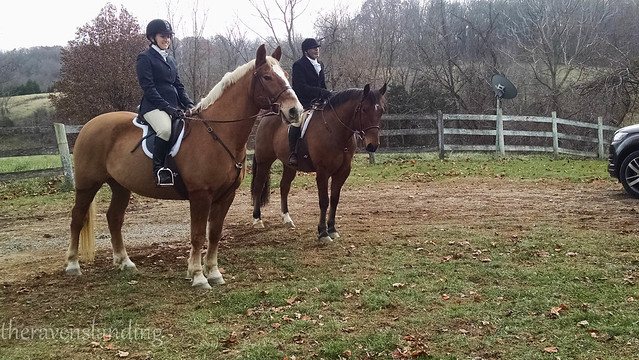
I had a few outings with Midas and the hunt that I felt were rather harrowing adventures. Galloping was fun for both of us, but waiting or walking around was the bane of my existence because he hated it (and I was so nervous about breaking social rules I’m sure I helped wind him up). We were the ones running down the hill bucking that no one thought would stick around the entire ride. Yeah. That was us. And we did stick it out. I learned to bridge my reins from a kind staffer and literally planted my fists in his withers so he pulled on his withers.
So, when the other two horses moved on from the barn, and it was just me, Midas, and the two younger siblings-in-law, I had a bit of a problem to solve. What to do with a big bully, who, when asked to trot, bolts for the gate? Who we can’t cool out on a long rein because he’s so uptight and untrustworthy?
I’m not sure why anymore, but I felt strongly that Midas needed to be tamed. He was so stand off-ish–he had reasonable ground manners but not fabulous ones.
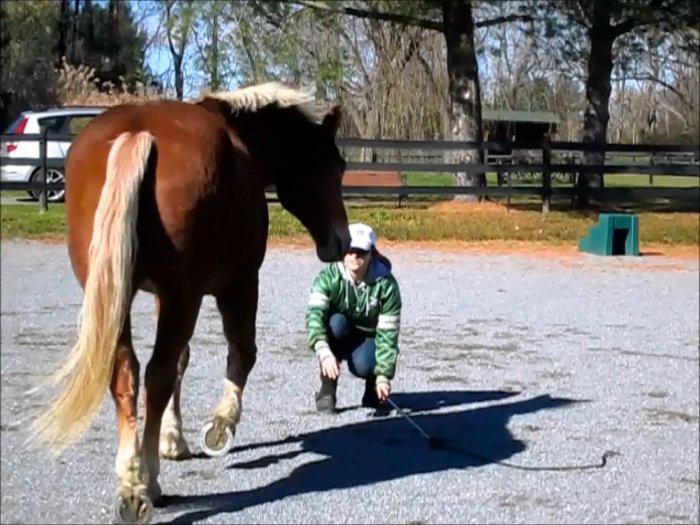
So day one was bonding. We stood around and patted him. All three of us. At the same time. He was so, so confused. It took him a good long while to relax. I started messing around with liberty work, theorizing that the way to deal with a horse who uses his strength against you is to change it from a game of strength to a game of communication. I needed to change the rules of his world.
He was so glad.
—
So our epic journey began. After taking baby steps with liberty training, I started taking lessons with a different trainer whose main focus was horse training rather than people training. My first riding lesson with the horse trainer was spent sitting on Midas and requiring him to stand still. Seriously. We barely even walked in the early lessons.
I suppose some people would have stopped taking lessons from her, then. I mean, we just stood there (while she talked about the theory of horse training), we want to ride, right??But I do want to ride, so I soaked up everything she said. It took a solid 15-20 minutes for him to give up on trying to walk off. The next time we rode, it was the same again. After a few rides (sits?), though, he got the message.
They also serve who only stand and wait.
I learned that the instant you sit on the horse, the horse needs to be listening to you and waiting for cues. If you can’t stand still, what’s to make you think walking will go any better? Much less dressage, or jumping, or fox hunting.
Why do we skip standing still?
This trainer saw what I was doing with liberty training on my own and introduced me to the Downunder Horsemanship book, as a means of making sure the training I did on my own was thorough, and didn’t miss any steps.
This whole thing has been life changing for my big bully.
To the point that I usually prefer to start beginners riding him in a halter–a halter–because their hands aren’t yet gentle enough to use a bit. And because Midas responds well enough in a halter for them to do beginner things like steering and learning about balance and brakes.
Oh yeah, this horse has brakes now, fantastic brakes. And he’s letting a tiny 7 year old boss him around (granted, I’m there, but considering where we started!).
Which brings me back to pondering my previous experiences with trainers, and in particular with the one whose only offered solution was a stronger bit. Why is that? What is the mindset? What makes us look at a horse and rider combination and say “Rather than focusing on remediation for the obvious lack of respect the horse has for you, let’s get you a stronger bit.” Or was the stronger bit supposed to fix the respect thing? Wouldn’t do much for the trust thing, though.
Wait, don’t panic: I know equipment matters. In fact, Midas is in a different bit now. One that doesn’t poke him in the mouth (a Myler, in case you’re curious). Before Midas, I spent the better part of a year trying to find tack that worked for my little gaited pasture potato–nothing fit, or he didn’t respond well to it for any myriad of other reasons (but he also liked the Myler best). But putting a different bit on Midas didn’t fix the problem, he needed training.
Every time you interact with an animal, you are teaching it what the rules are for interaction with you. The animal can do nothing but interpret your actions through the lens of its instincts–what it knows as a herd or pack animal. You are demonstrating what their relationship is to you, and who is in charge. Every. Single. Time.
You don’t have to consider yourself a horse trainer to train a horse, you just have to try to catch one. The line in the sand starts on the ground. (Ha.Ha.)
I know, not every horse/rider pair can be fixed with training. Horses (and people) do have personalities, hormones, and any number of other factors. In fact we just had a horse leave the farm because he wasn’t a good fit (ironically, with anyone at the farm). He’s at a lesson barn now and they apparently love him. I thought for sure he’d be glue after a week there, but he must get enough work that he doesn’t have time to be trouble. Even the other horses here are happier now that he’s gone.
This whole experience has me curious about, well, every horse and rider I’ve ever encountered. What if someone could have offered this training for Melody ? Or even Dude?
One of the things I’ve incorporated into Midas’s training is a variety of riders. I’m trying to teach him, and I think it’s working, that he can be kind to riders. That he should be kind to riders. That kindness will, in fact, be a good experience for him. Better than brashness and bullying. Even if the rider is a rank beginner. It’s hard to say, since his 7 year old has boundless willpower, but I think he’s getting it.
—
Reflecting on this riding and training journey makes me think that if I ever taught horseback riding, I would have a very hard time separating mounted work from groundwork. You need both, to really forge a bond and understanding. (Groundwork, here, doesn’t refer to any particular exercise or method, but rather literally refers to working on the ground with whatever issues need addressing). Riding isn’t about equitation, it’s about teamwork. Equitation is what keeps you on the horse and lets you move your aids to communicate with your teammate.
I feel like, were I to run a lesson program, ever, it would be an unconventional one. (Those who know me are like, “Really, you’re just figuring this out?”) If you are starting a rider from scratch, it’s relatively easy: You make them focus on balance, on staying on, on moving with the horse. Then once they aren’t afraid of randomly pitching off the side, you can start messing with where they should hold their hands.
You teach in terms of “Hey, if you want the horse to turn left you just put your leg here and voila! To make that tight turn, use all the aids! With conviction!”
With people who have been riding? I don’t know. I guess it depends.
—
I have this deep desire to understand why a horse does things, or a horse and rider combination does things.
I also want to understand why trainers do and say the strange things they do.