What is it about fences?

Midas is a foxhunter. Though, he hasn’t gone much in the past 4 years. The hunt he typically goes out with isn’t really a break-neck crazy crew. They jump teeny logs at a run through the woods, sure, but if they come up to anything remotely serious they stop and going over one at a time in a pretty orderly fashion.

Midas is fully capable of jumping big fences from a trot.

But when we first started popping him over tiny jumps he charged them. Like, itsy bitsy x rails and he would launch at them from several strides away and hurl himself over, often bucking on the other side. I noticed that he often bucked after hopping logs, too.

It could just be exuberance.

We spent two summers casually sneaking in work over small jumps, endeavoring to teach Midas that jumps are casual affairs. No charging necessary or desired. Last year the fruits of that labor really started to show, we could randomly and casually take a little bounce that was set up in a corner of the ring. Midas would ride up like a gentleman, own the bounce in style, and canter out slowly. He was happy, we were happy.

Progress.

Well, then we upped the anti–maybe too much?–with that little jumper show. We schooled pretty hard for it in the few days beforehand, and then had a very exciting little show. In which Midas owned the trotted x rails with only a little nervous rushing, and then we had a disaster on the 2′ fences, and then we came back and jumped individual fences quietly, but didn’t even remotely mess with doing a course.

Now, in the midst of prep for the show my trainer asked me to pick up canter with the intent to canter jump. Midas did something he hasn’t done at home with me–ever–and gave a genuine buck and took off. He didn’t get far, I stopped him, and then we had a nice obedient canter depart and left cantering fences for a different day.

By the end of the lesson he was being a serious champ about trotting whatever combination I asked of him. Even some with tricky steering.

So, at the show, he kind of ducked and crow hopped after almost every 2′ fence. Except fence 4, which according to the trainer there was an inviting fence–and fence 5, which was the first of a simple line that had three canter strides between 5 and 6. Well, shame on me, I didn’t sit up enough for those canter strides, got jumped out of the tack on 6 and this time fell off when he did his duck and crow hop routine.

Then we had digging out to do in the warm up, and it didn’t occur to me until too late today that Midas hasn’t jumped a combination since then. I’ve been traveling, we’ve had visitors, and I felt like I had a bit of sweeping up to do to remind him of all the things that haven’t changed.

The Ham was riding Midas today–the Ham is 17, and has been riding with me for 6 years, much of that time on Midas. He went to pop over the teeny tiny x rail in and out. Shouldn’t have been a big deal. Two months ago I don’t think it would have been a big deal. Might be wrong, but…

The ride, up until the moment he pointed Midas at the combination, had been exceptionally quiet and easy going. But Midas launched himself at the first x rail and then lurched sideways–running out from the second fence and making for the gate.

The Ham rode the run-out fine, but the saddle slipped onto Midas’s side and the poor Ham was dumped roughly on his back.

Midas stopped a few feet away and stood like a statue. He didn’t move a muscle and starred at the Ham as the poor guy struggled to catch the wind that had been knocked out of him. Once the Ham was on his feet again I went to Midas, who continued to stand so still that I was afraid he was hurt. I checked him over. Nothing that I could see.

I fixed the saddle, tightened the girth, led him to the mounting block and got on. He felt sound but hesitant. Like he expected something bad to happen. We did some transitions up and down, he wasn’t wound up, but rather hesitant and almost nervous.

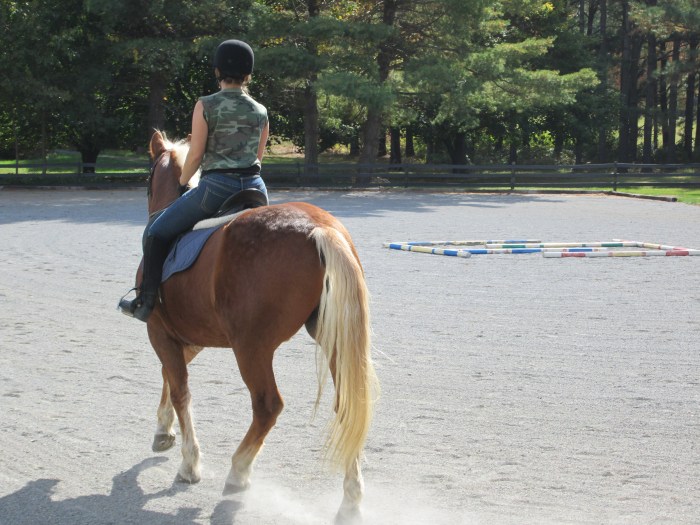
We went to grassy area with the teensy x rails and walked around them. He was nervous again–now Midas’s nerves do not mean skittishness and shying generally, Midas nerves mean head up and charging. We walked over the tiny jumps, threw in some trot transitions. Each time he would seize up and get tense, and I’d have him walk again. I had the Ham put the tiny x rails down to poles and we walked and trotted over those both ways, then he put one up to an x rail and we walked and trotted that a couple times.

Midas would start to tense, then listen when I soothed him. He trotted the solitary x rail reasonably, even if he needed to be ridden up to the base as if it were a big scary jump.

Then the Ham got back on, good man, and basically started the whole procedure over again from scratch. They didn’t get to popping over the one jump, but they started from a more nervous place and ended relaxed. Mostly relaxed, anyway.

So what is it?

I’ve noticed that when there is a fall, Midas gets freaky about what he was doing when the fall happened. Never mind that he’s usually a contributing factor to the fall, but he gets squirrely about doing that thing again.

It’s like his thought process is “Nope, last time I jumped two in a row someone fell off and it was scary and I got in trouble so I am NOT jumping two in a row.” or “Last time I cantered a jump it didn’t go well, not happening.”

Susu, our trainer, with whom we only get to ride a few times a year, says that he doesn’t have any tools in his toolbox to deal with jumping. He’s got athletic ability, and has relied on that to survive.

This would explain the charging.

I know that I don’t have a lot of experience cantering fences (neither does the Ham). I was never stellar at seeing distances, and only cantered courses a handful of times in my high school days (yay for the constraints of a 20 x 40 dirt arena in the north). There just hasn’t been opportunity since. I know that I don’t necessarily ride him as strongly as he might want or need when there are two fences in a row. So there is that.

This would explain the abashed behavior when people fall off. He always seems so surprised when he loses a rider.

If Monty Roberts is right about the wiring of horses, I need to approach this the same way I would approach a person who had something scary happen. Keeping at it in as low pressure of a fashion with as much support as he needs to not panic and figure out that he can, in fact, handle it.
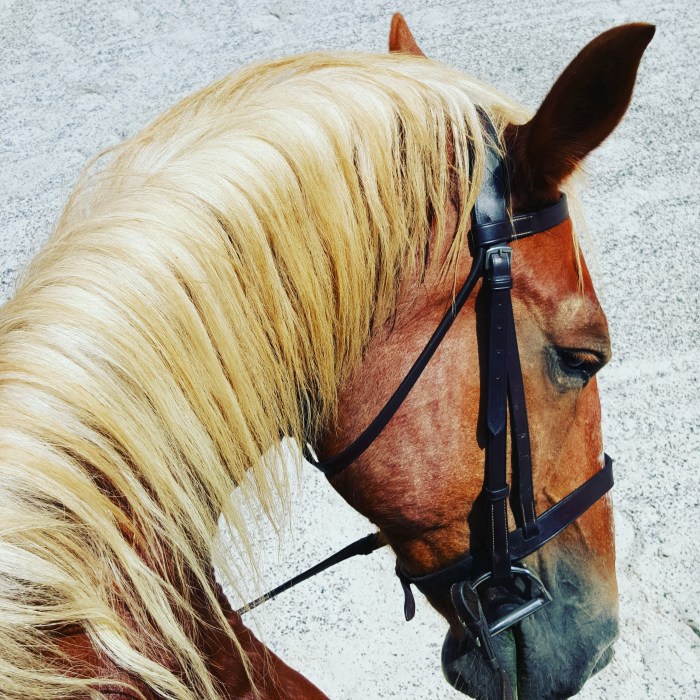


Chomping

Midas has this annoying little habit of yanking on the reins when he’s standing. He’s done it as long as I’ve known him, and it’s pretty much never been a priority for me to deal with.

First lesson was don’t move your feet without permission. There were days when it was 10-15 minutes before I asked him to walk from the mounting block because he would not wait for permission to leave.

Those days are past (not without occasional reminders) and we’re not working well enough under saddle that I feel I can spare some time to work on the yanking habit.

My seat has improved to the point that when he yanks he’s mostly just yanking on himself, he does not succeed in pulling me out of the saddle or the reins out of my hands. (Yay for tucking your seat under!)

But it’s a habit, and he still does it.

Monty Roberts once recommended in his “Ask Monty” column that you back a horse each time he yanks, eventually he’ll figure out that if he yanks he has to work more. I originally intended to pursue this method, but I may have stumbled on something simpler for Midas.

Yesterday I took the time to throw halt transitions in with our regular work. Not just halt, but halt and wait. It only takes a couple seconds for Midas to yank on the reins. Then we would wait more. When he passed the couple seconds mark wihout yanking (often replaced with a sigh) then I give him a loose rein.

Then I gather up the reins again and wait (this is often accompanied by feet shuffling, which I wait out, since I didn’t ask him to move his feet and he’ll get no reward for it.) Once he is standing, and accepts the contact–passing that couple second mark without yanking (again, usually accompanied by a sign) I give him a loose rein. After repeating this a couple times, I ask him to move forward. Sometimes with contact, sometimes without.

He responded really well. Each time we did this there was less yanking and more waiting quietly. The last time I don’t remember him yanking at all.

I’m sure it will take more than one ride to break a habit he’s had for at least 10 years, but I think he’s starting to realize what he’s doing and that there is a better way.


Science and the horse

Scientists are studying equine social behavior, now. No horse person is surprised, but they keep finding out that horses are insanely smart, learn body language, words, and problem solving skills. Some horses definitely have more problem solving skills than others. I can’t wait  for them to do a study comparing horses, ponies, donkeys and mules.

NBC recently reported that horses remember people and how they were treated for long periods of time. And the entire equestrian community said “Um, yeah…this is why training works and abused horses have a lot of emotional baggage forever.” All the same, I enjoyed reading the article.

It confirmed my own experimentation. Don’t worry, I didn’t go around mistreating one horse and pampering another. A couple years ago I watched a Tommie Turvey clinic and in the Q&A afterwards a little girl asked him how he got horses to like him. He paused, then said he tries to do something nice for the horse that it cannot do for itself–such as scratching a hard to get spot. Simple enough. Not unlike making friends with a human, doing something nice goes a long way.

For the past couple years I’ve been really focused on Midas and haven’t really paid much attention to the other horses at the barn. So, I decided I would make it a point to greet the other horses because they notice when you don’t. There were four others at the time, one has since passed on of old age, so now there are only three others to greet. In summertime it’s easier because they are in during the day, so I go around and pat everyone before fetching Midas.

At first they were slightly suspicious when they discovered I was coming to see them–and also not bearing treats. But I told them I wasn’t bearing treats, asked them if they wanted pats, and tried to give them a nice scratch in an itchy place before moving on. Eventually they caught on and they usually come to their gates to say hello and get their scratches.

It helps, I think, that I use a lot of the same phrases–things like, “No treats today, just pats” or “hey, do you want a treat?” so they know what I’m asking and decide for themselves if they feel like moving their feet to get their whorl rubbed or the spot under their manes scratched.

Most of the time they do. It’s always gratifying when someone is glad to see you.

The NBC article also talked about horses hearing humans even better than dogs do, suggesting that verbal commands will be met with great success–which confirms what I’ve observed (especially working with Midas): Horses definitely learn words, and tone is huge.

Barking orders at a horse–particularly commands like “whoa” or “stay” is entirely counterproductive because your tone is saying “jump!” “run!” “I eat you!” so obviously the horse is not going to respond with the desired slowness and relaxation.

Even barking “trot” will result in a much uglier up transition to a much more tense trot than crooning out as gentle a command as you can manage with a “t” at the front and back of the word. I witnessed my youngest brother-in-law growling out commands the way most kids are taught to address ponies. You know, that “do it now or face the consequences” tone that ponies always seem to invite, and then ignore. It was freaking Midas out. When I convinced my brother-in-law to breathe out his commands in a soothing tone, Midas responded just as quickly as before and much more quietly. Suddenly they could go around transitioning up and down in a relaxed fashion.

It made me re-evaluate how we’re taught to address ponies–but at the moment I don’t have access to any so I can’t experiment.

When I was a teen exercising horses in winter, I accidentally taught my mount a verbal half halt. Before asking him to canter–or gallop, we had a lot of fun out on the trails together–I always asked him “Are you ready?” I don’t know why, I just did. Of course, he figured out really quickly what I was going to ask for next, so even without half halting he would shift his weight back, ready to launch.

I’ve started asking Midas “Are you ready?” before most transitions, up or down. It’s a verbal reminder, which I think he appreciates, something that doesn’t require nagging at him with my hands or legs. I try not to nag in general, but this is another “nice gesture” I can offer to this particular horse.

I’ve already mostly taught him “right and left” so I can give him a heads up when leading him–with or without a rope–but I haven’t yet figured out how to control that when he’s at liberty. Another goal that I don’t know how to reach is refining “stay” and “come” so that I can ask him to come a few steps and stop–before reaching me–like sheep dogs do.

Anyway, all that to say: Science is catching on!


Operation Bridleless

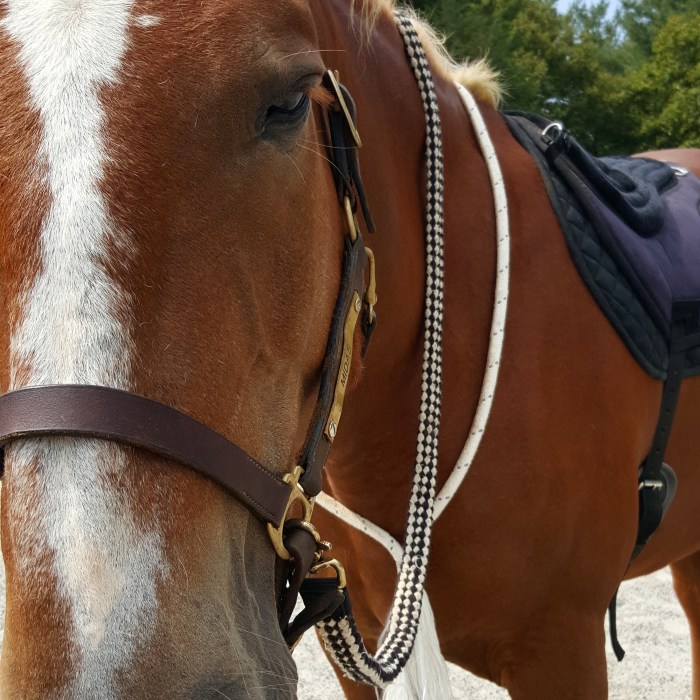
I want to be able to ride Midas, formerly the bully freight train, bridleless and halterless. He already goes quietly in a halter–before I broke my foot I was cantering him in a halter. The time off from the foot was a serious set back for me, and set back our ridden work. So we have some making up to do.

But, we did a lot of groundwork that year. A lot. And we made huge strides.

So, why couldn’t he be one of those horses that goes in a neck rein or less?

I read a Buck Brannaman article on Eclectic Horseman that gave a deceptively simple exercise for laying the foundation–ride a serpentine using only your legs to steer. Makes sense, right? Simple, right?

Hahahahaha.

Ugliest serpentines I have ever ridden.

But….we’re making progress.

I’ve sort of combined that with Clinton Anderson’s Follow The Fence exercise, which we never really spent a lot of time on due to very little in the way of regular fencelines at this property. But I’m messing with the exercise now–using only my legs to direct Midas to stay on the path, as much as I can, anyway.

Anything that involves freedom excites him in a good way, but he hasn’t totally figured out what I want yet so he hasn’t fully embraced the responsiveness. He thinks that no rein means he can go where he likes as long as he keeps the pace I tell him. That is very similar to cruising–where he could go where he liked as long as he kept the pace. Now I just need to convince him to listen to my legs.

It HAS been working, he’s much more sensitive to leg pressure in general now, which is great. We still have pretty ugly serpentines, but I can actually float my hands over the reins without him immediately checking out.

Baby steps.

IMG_3206

First Jumper Show

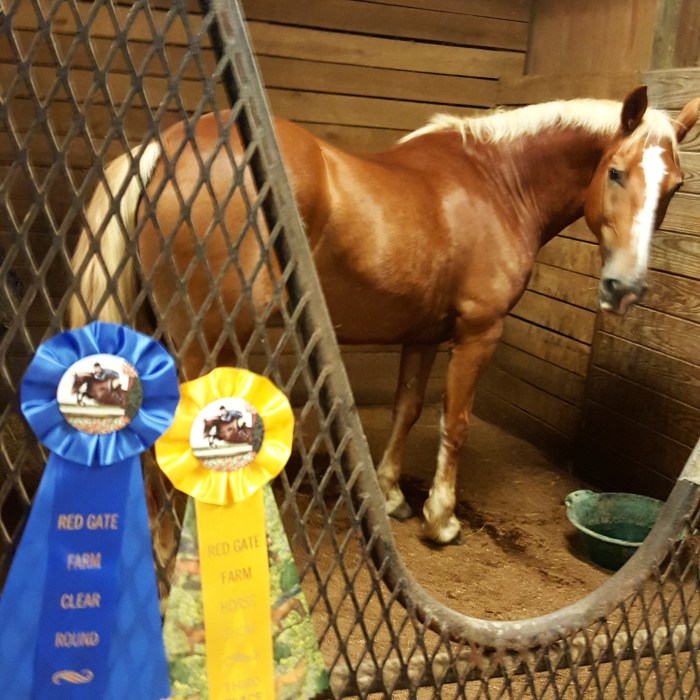
IMG_20160825_082947I have never done a jumper show before, and I think I understand now why people love jumpers so much. It’s a lot of fun to test your skills zipping around a course as fast and clean as you can. Or, I imagine it would be. Our goal was to not zip, just to go around the course quiet and relaxed.
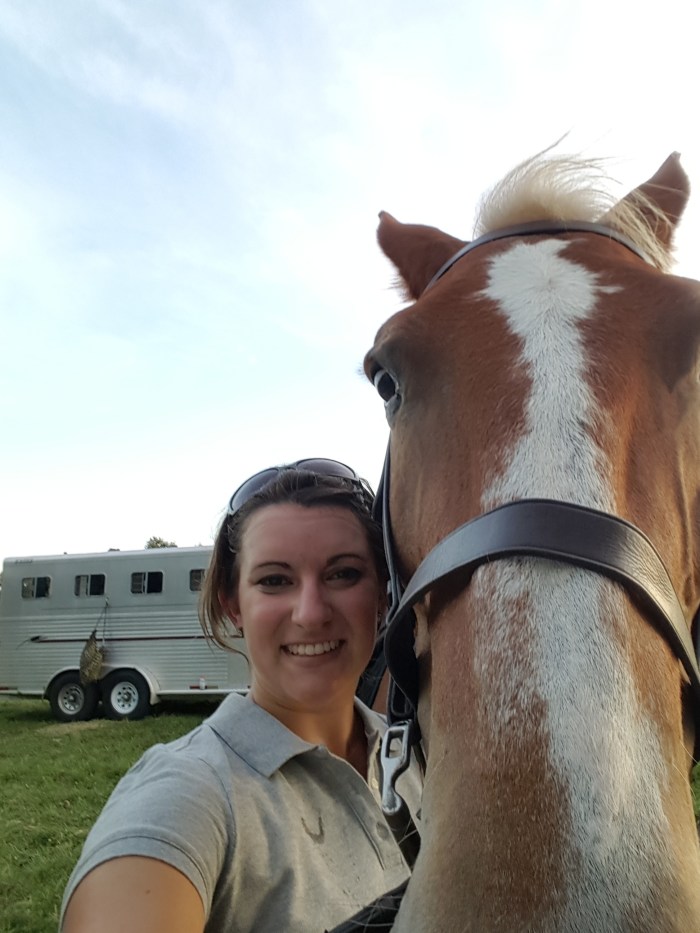
And you know what: We went off farm, I got on, and Midas listened in the warm up ring. He was good, we trotted both ways, then we went and got in line for the x rails course. Just to introduce him to the course. He was excited, but he listened well and went around pretty relaxed. We got a clean round and a good time (without trying for time). I was very pleased with him.

Then we loitered around for an hour while the x rails course finished up and the 18″ verticals class went.

As the hour passed between our classes, Midas knew he’d done a good job–stellar, even, especially considering his track record–he thought he was done, and he also knew it was dinnertime. So, when I woke him up to warm him up I could sense that he was offended about working more. I hoped we could just do our class and be done. Also, we hadn’t jumped warm up jumps before the x rails, and that had gone great, so I thought perhaps it would  be the same with the 2′ fences. In hindsight, I should have stayed in the warm up ring until he got over being offended. I should have taken the x rail and vertical in the warm up ring to discover his mood.

I was trying to help him get over being in work by not dwelling too long. It didn’t work. Our second class went horribly. Though, watching it later it doesn’t look that horrible up until the point I fell off. He was a handful, but mostly we were managing with extra circles to recover.

He was wound up, and shocked and offended, and I could feel him utterly coiled beneath me. He tried several times to get out of line while we were waiting, and when it was our turn to enter he tried to leave. He bucked and bolted after the first fence but I got him back and circled. I kept him from the second fence because I strongly suspected we’d have a buck and bolt on the other side of that one too. After a couple circles I felt his energy had shifted forward rather than up, and got him over with a reasonable recovery.  The third fence got a teeny buck and dart, which I recovered, circled and got him to fence four. I was approaching each fence like it was the only one. He took four without darting out of it, so I started to think we might be OK–not great, but maybe OK. But five and six were a line and I wondered if I should quit, knowing a line would give him the jump on me–literally.

Perhaps I should have quit.

Perhaps I should have pretended six wasn’t after five and sat up with the world’s biggest half halt in our two strides between fences.

Perhaps I should have sat up and ridden the fences like they were flat.

Any of those actions might have changed the fact that he jumped big on six and dislodged me, then I could’ve sworn he bucked–but in the video it wasn’t nearly the motion I felt, but just like that I was in the dust. I wasn’t embarrassed at the time, but watching the video I definitely am now!

So I left the ring and took him back to the warm up ring, got on, and spent the next half hour or so trotting the x rail and vertical in there. It only took a few times over the x rail (and one or two one rein stops before then) to get him listening again, and then I just did the vertical over and over waiting for him to take revenge. But he didn’t.

So we went back into the show ring–not to do the course, but to recover from it. We walked and trotted around–he was immediately worked up, and I just needed him to relax. So we trotted around–ooogled at the photographers laying in the grass outside the ring every single pass. After a little while I asked him to walk, did some half halts to focus on my release, focused on relaxing my legs, and then asked for trot and we did much better at achieving a relaxed trot. So it was time to try a fence.

On the recommendation of one of the show staff, we chose the straight approach to the four fence (since the other inviting fence was on the side with the scary photographers) and he trotted in and out like a good boy. No rushing. No bucking. Just a nice trot.

That’s a win. I let him walk and showered him with pats.

I was reflecting on the event and realizing that it did actually go much better than the dressage show. He came out and his first reaction was to be quite good. He knew he had been good, and he thought he was done–when he found out he wasn’t done, and the next thing was even harder, he just got more shocked and offended and worked up and then lost three years of training.

I think that if I had jumped him in warm up I would have been able to head off our disaster. I don’t think it would have been a great round, but I think I could have stayed on. So, lesson learned. After a long break, make sure to work him hard before asking for anything really hard.


20160824_193236