Watercolors

Made a color wheel with watercolors for the first time ever.

I had art books when I was a kid–lots of them, actually–but never an art class. It was only after college that I decided to make a concerted effort to get better at drawing.

My first move was to buy a coffee table book of Da Vinci’s sketches. That helped. Mostly just buckling down and practicing at all helped.

My mother-in-law is a painter and is offering friendly classes out of her home now. I think I’m going to learn a lot.

20160929_080456.jpg

What is it about fences?

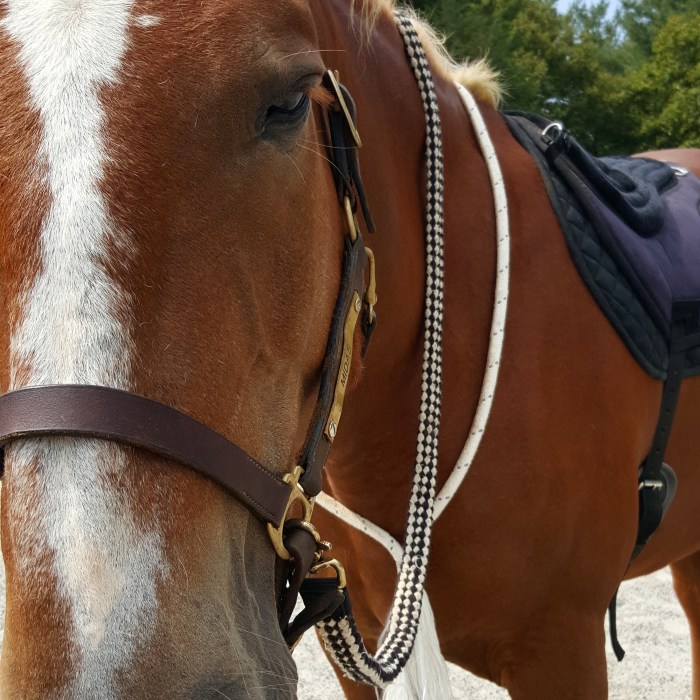
Midas is a foxhunter. Though, he hasn’t gone much in the past 4 years. The hunt he typically goes out with isn’t really a break-neck crazy crew. They jump teeny logs at a run through the woods, sure, but if they come up to anything remotely serious they stop and going over one at a time in a pretty orderly fashion.

Midas is fully capable of jumping big fences from a trot.

But when we first started popping him over tiny jumps he charged them. Like, itsy bitsy x rails and he would launch at them from several strides away and hurl himself over, often bucking on the other side. I noticed that he often bucked after hopping logs, too.

It could just be exuberance.

We spent two summers casually sneaking in work over small jumps, endeavoring to teach Midas that jumps are casual affairs. No charging necessary or desired. Last year the fruits of that labor really started to show, we could randomly and casually take a little bounce that was set up in a corner of the ring. Midas would ride up like a gentleman, own the bounce in style, and canter out slowly. He was happy, we were happy.

Progress.

Well, then we upped the anti–maybe too much?–with that little jumper show. We schooled pretty hard for it in the few days beforehand, and then had a very exciting little show. In which Midas owned the trotted x rails with only a little nervous rushing, and then we had a disaster on the 2′ fences, and then we came back and jumped individual fences quietly, but didn’t even remotely mess with doing a course.

Now, in the midst of prep for the show my trainer asked me to pick up canter with the intent to canter jump. Midas did something he hasn’t done at home with me–ever–and gave a genuine buck and took off. He didn’t get far, I stopped him, and then we had a nice obedient canter depart and left cantering fences for a different day.

By the end of the lesson he was being a serious champ about trotting whatever combination I asked of him. Even some with tricky steering.

So, at the show, he kind of ducked and crow hopped after almost every 2′ fence. Except fence 4, which according to the trainer there was an inviting fence–and fence 5, which was the first of a simple line that had three canter strides between 5 and 6. Well, shame on me, I didn’t sit up enough for those canter strides, got jumped out of the tack on 6 and this time fell off when he did his duck and crow hop routine.

Then we had digging out to do in the warm up, and it didn’t occur to me until too late today that Midas hasn’t jumped a combination since then. I’ve been traveling, we’ve had visitors, and I felt like I had a bit of sweeping up to do to remind him of all the things that haven’t changed.

The Ham was riding Midas today–the Ham is 17, and has been riding with me for 6 years, much of that time on Midas. He went to pop over the teeny tiny x rail in and out. Shouldn’t have been a big deal. Two months ago I don’t think it would have been a big deal. Might be wrong, but…

The ride, up until the moment he pointed Midas at the combination, had been exceptionally quiet and easy going. But Midas launched himself at the first x rail and then lurched sideways–running out from the second fence and making for the gate.

The Ham rode the run-out fine, but the saddle slipped onto Midas’s side and the poor Ham was dumped roughly on his back.

Midas stopped a few feet away and stood like a statue. He didn’t move a muscle and starred at the Ham as the poor guy struggled to catch the wind that had been knocked out of him. Once the Ham was on his feet again I went to Midas, who continued to stand so still that I was afraid he was hurt. I checked him over. Nothing that I could see.

I fixed the saddle, tightened the girth, led him to the mounting block and got on. He felt sound but hesitant. Like he expected something bad to happen. We did some transitions up and down, he wasn’t wound up, but rather hesitant and almost nervous.

We went to grassy area with the teensy x rails and walked around them. He was nervous again–now Midas’s nerves do not mean skittishness and shying generally, Midas nerves mean head up and charging. We walked over the tiny jumps, threw in some trot transitions. Each time he would seize up and get tense, and I’d have him walk again. I had the Ham put the tiny x rails down to poles and we walked and trotted over those both ways, then he put one up to an x rail and we walked and trotted that a couple times.

Midas would start to tense, then listen when I soothed him. He trotted the solitary x rail reasonably, even if he needed to be ridden up to the base as if it were a big scary jump.

Then the Ham got back on, good man, and basically started the whole procedure over again from scratch. They didn’t get to popping over the one jump, but they started from a more nervous place and ended relaxed. Mostly relaxed, anyway.

So what is it?

I’ve noticed that when there is a fall, Midas gets freaky about what he was doing when the fall happened. Never mind that he’s usually a contributing factor to the fall, but he gets squirrely about doing that thing again.

It’s like his thought process is “Nope, last time I jumped two in a row someone fell off and it was scary and I got in trouble so I am NOT jumping two in a row.” or “Last time I cantered a jump it didn’t go well, not happening.”

Susu, our trainer, with whom we only get to ride a few times a year, says that he doesn’t have any tools in his toolbox to deal with jumping. He’s got athletic ability, and has relied on that to survive.

This would explain the charging.

I know that I don’t have a lot of experience cantering fences (neither does the Ham). I was never stellar at seeing distances, and only cantered courses a handful of times in my high school days (yay for the constraints of a 20 x 40 dirt arena in the north). There just hasn’t been opportunity since. I know that I don’t necessarily ride him as strongly as he might want or need when there are two fences in a row. So there is that.

This would explain the abashed behavior when people fall off. He always seems so surprised when he loses a rider.

If Monty Roberts is right about the wiring of horses, I need to approach this the same way I would approach a person who had something scary happen. Keeping at it in as low pressure of a fashion with as much support as he needs to not panic and figure out that he can, in fact, handle it.




The Dark Knight Rises

Note: This post originally appeared 8/16/2012 on my other blog. 

This brings us to The Dark Knight Rises. Spoiler Alert. Just in case you still haven’t seen the movie. Though, it’s been out so long that all plot points are fair game.

A perceptive youtuber made this Batman trilogy supertrailer with a voiceover from the Prestige (conveniently, it’s Michael Caine’s voice, who you hear as Alfred): And truly, if Nolan had to do major re-thinking of his trilogy after the death of Heath Ledger, the story did not suffer. Dark Knight mostly stood on its own, even though it built on the foundation of Batman Begins. TDKR, however, really relied heavily on the prequels and in a sense knit them together into a complete whole.


I was completely torn about going to see TDKR, but had to since I’d seen TDK. I kept comforting myself that I would get to see Anne Hathaway as Catwoman (and she did an excellent job).

I’m glad I went–though I was wound very tight until about halfway through the movie when I realized it wasn’t going the direction I thought it would. The last act of the trilogy, the prestige, itself has three acts, the descent, the pit, and the rise.
Act 1:
Ra’s al Ghul: You used all the tools I taught you… for a city that was corrupt, and a victory based on a lie. Now your failure will be seen…

TDKR takes place 8 years after TDK. 8 years of the noble lie cleaning up Gotham’s streets and tortuing Gordon’s soul, and Bruce Wayne holing up like a hermit in Wayne Manor (rebuilt after the ashes of Batman Begins!) while nursing his (physical and emotional) injuries from his fall in TDK.

Bruce and Gordon are struggling with the effects of their big fat noble lie. Bruce still thinks it was a good idea–but he is definitely not facing his pain about Rachel’s death, Dent’s fall, and Batman’s scapegoat status. He’s driving Alfred crazy. I don’t think Alfred can quite decide what a healthy Bruce would look like, but he knows that what he’s looking at is not it. By the way, even Alfred told a lie at the end of TDK, and he regrets that he hid Rachel’s choice from Bruce (she chose Dent). Alfred’s chief fear is that Bruce is not interested in living.

The only glimmer of life in Bruce’s eyes comes from Selina Kyle–the Catwoman. He catches her breaking into a safe in his house and is clearly intrigued by her. He sees something to her that most don’t. She’s a catthief with emotional issues that make her a little more complicated than others. He puzzles her a bit, too. That stupidly rich (but, admittedly handsome once he cleaned up) hermit who didn’t turn her in to the police but was fully capable of tracking her down himself.

Alfred: [about Selina Kyle] You two should exchange notes over coffee.

Bruce Wayne: So now you’re trying to set me up with a jewel thief?
Alfred: At this point, I’d set you up with a chimpanzee if it’d brought you back to the world!

The spark brought by both Selina and the mysterious person she is working for fans into flame when Bane shows up. Bruce is glad of the chance to be Batman again. He rather blithely steps back into the cowl (against Alfred’s wishes, see “not interested in living” above) with little preparation and walks right into the first villain who is physically stronger than Batman. Batman is promptly defeated and sent to hell. Bane’s definition of hell is a place that holds out a little thread of false hope–leaving you to hope and have your hopes dashed again and again because there really is no way out.
Act 2:
Bruce Wayne: Why didn’t you just… kill me?

Bane: You don’t fear death… You welcome it. Your punishment must be more severe.
Living in hell isn’t on Bruce’s list of things to do. He wants to die, but has a deep inner obligation to die fighting. Bruce talks in circles with a doctor who has lived in the pit for years. The doctor helps fix Bruce’s back, but also gets him to admit that he doesn’t fear death, and that’s part of his problem. There is a difference between risking your life for someone and wanting to live, and risking your life for someone and wanting to die. You’re much more likely to fail when you don’t desire life enough to try harder than you think you can (see chapter 10 of The Horse and His Boy by C.S. Lewis). When Bruce realizes that he has to let go of his martyr complex, his deathwish, and the idea that he’s irrepairbly broken (body and soul), then he has what it takes to rise from the pit. He had to let go of failure, of Dent, of Rachel, of his parents’ murder, and do what Alfred had been trying to get him to do: embrace life.
Act 3:
Bane: So, you came back to die with your city.
Batman: No. I came back to stop you.

Bruce Wayne, back from the dead, once again fit and filled with new zeal, makes his way back to Gotham–back to the world. In many ways, the pit was the only thing that brought Batman back and made Batman the legend he was meant to be. While he was gone Bane ruthlessly undid the noble lie as part of his undoing of Gotham–he tore down the white knight who was their shining example and used that as justification for the Reign of Terror. It was hard not to watch Bane’s rule without thinking of the French Revolution. Anyone who could be deemed a “have” was evil and overrun by anyone who could be deemed a “have not.” To have was to be evil, unless of course you were a have not three seconds ago. Hate to get into politics, but it also bears resemblance to a certain movement whose main complaint is that some people have more than they do (but they are unwilling to share their ipads with the homeless guys who don’t have ipads).   Bane: We take Gotham from the corrupt! The rich! The oppressors of generations who have kept you down with myths of opportunity, and we give it back to you… the people. Gotham is yours. None shall interfere. Do as you please. Start by storming Blackgate, and freeing the oppressed! Step forward those who would serve. For and army will be raised. The powerful will be ripped from their decadent nests, and cast out into the cold world that we know and endure. Courts will be convened. Spoils will be enjoyed. Blood will be shed. The police will survive, as they learn to serve true justice. This great city… it will endure. Gotham will survive!

This is the lie Bane feeds the people to encourage them to destroy themselves and descend into chaos. Gotham does descend. There is a moral group that struggles to get by keeping its head down–the police force has been trapped in the train system underground and has done nothing but count the days till they can get out to reckon with the escapees from Arkam. Oh yeah, and there is a deteriorating nuclear-type-bomb rolling through the streets, which will eventually go off after a period of Bane’s torturous false hope.

To all this madness returns the Batman–more a man than he has ever been before. He finds his allies, makes allies out of others–namely Selina Kyle–and sets about systematically warring against Bane. Catwoman joins forces with Batman because Bane’s Gotham was never something she wanted.  She’s also kinda stuck on the guy who has displayed unprecedented forgiveness and faith in her (perhaps the film could have been the Redemption of Selina Kyle). Plus, she’s definitely a girl more his speed than any others he’s had in his life.

In the end, it’s a pretty awesome climax. A fitting end for Batman’s journey that started when his parents were murdered in a dark alley. He has finally found himself, and only now could he truly sacrifice himself for Gotham.

Batman: A hero can be anyone. Even a man doing something as simple and reassuring as putting a coat around a little boy’s shoulders to let him know that the world hadn’t ended.

Jim Gordon: Bruce Wayne?
Others have commented that TDKR was not as realistic as TDK, and I would agree. The plot has a few more fantastical elements that require suspension of disbelief–or require you to remember that this is actually a comic book movie.
It’s also interesting to note that the passage read at a certain key funeral at the end of the film is from Dicken’s A Tale of Two Cities, (a story set during the Reign of Terror, incidentally). The passage is from Sydney Carton’s final words before he goes to the guillotine in place of Darney (the man loved by the woman Sydney Carton loves).
I see a beautiful city and a brilliant people rising from this abyss. I see the lives for which I lay down my life, peaceful, useful, prosperous and happy. I see that I hold a sanctuary in their hearts, and in the hearts of their descendants, generations hence. It is a far, far better thing that I do, than I have ever done; it is a far, far better rest that I go to, than I have ever known.

I’m growing to love this movie, actually. It’s a nuanced and rich story, with many themes, many good points, and many quotes. It’s not heavy handed, it’s a story that speaks for itself. I’m hesitant to really give away the ending, even though most folks have seen it by now. Suffice to say that I was happy. Gotham has the hero it needs, and Bruce Wayne has finally found peace.

Chomping

Midas has this annoying little habit of yanking on the reins when he’s standing. He’s done it as long as I’ve known him, and it’s pretty much never been a priority for me to deal with.

First lesson was don’t move your feet without permission. There were days when it was 10-15 minutes before I asked him to walk from the mounting block because he would not wait for permission to leave.

Those days are past (not without occasional reminders) and we’re not working well enough under saddle that I feel I can spare some time to work on the yanking habit.

My seat has improved to the point that when he yanks he’s mostly just yanking on himself, he does not succeed in pulling me out of the saddle or the reins out of my hands. (Yay for tucking your seat under!)

But it’s a habit, and he still does it.

Monty Roberts once recommended in his “Ask Monty” column that you back a horse each time he yanks, eventually he’ll figure out that if he yanks he has to work more. I originally intended to pursue this method, but I may have stumbled on something simpler for Midas.

Yesterday I took the time to throw halt transitions in with our regular work. Not just halt, but halt and wait. It only takes a couple seconds for Midas to yank on the reins. Then we would wait more. When he passed the couple seconds mark wihout yanking (often replaced with a sigh) then I give him a loose rein.

Then I gather up the reins again and wait (this is often accompanied by feet shuffling, which I wait out, since I didn’t ask him to move his feet and he’ll get no reward for it.) Once he is standing, and accepts the contact–passing that couple second mark without yanking (again, usually accompanied by a sign) I give him a loose rein. After repeating this a couple times, I ask him to move forward. Sometimes with contact, sometimes without.

He responded really well. Each time we did this there was less yanking and more waiting quietly. The last time I don’t remember him yanking at all.

I’m sure it will take more than one ride to break a habit he’s had for at least 10 years, but I think he’s starting to realize what he’s doing and that there is a better way.


The Dark Knight

via

Note: This post originally appeared August 1, 2012 on my other blog. 

Four years ago, when they were promoting The Dark Knight, I decided that I probably didn’t want to see it because I didn’t want to see the Joker.

The Joker is one of the best Batman villains, and my favorite Joker of all time is the one from the Batman/Superman Adventures voiced by Mark Hamil (you might remember him better as Luke Skywalker). Having seen Tim Burton’s Joker, I knew that the mad clown wasn’t nearly as fun when translated to the live action world–he was probably one of the scariest villians possible, and the Joker of Nolan’s gritty Gotham was undoubtedly the most terrifying villain ever. The Joker of the animated series was after two things; money, and besting “Bats”–the Joker of TDK was after one thing; pushing Batman over the edge. After the untimely death of Heath Ledger I was even less interested in plumbing the depths of evil with the Dark Knight.

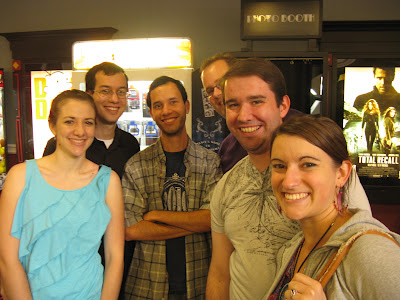
in line for the Dark Knight Rises

Every now and then Zorro would tell me that TDK was one of the best done films he had ever seen, but it was a hard film to watch. I would agree with him (having known all the major plot points and twists since it was released) and that was that. As everything built up to the release of The Dark Knight Rises my curiousity got the better of me and on TDKR’s opening day I finally watched The Dark Knight. I’m glad I did. I’m also glad that it was 4 years before my morbid curiousity got the better of me! At least I could watch TDKR shortly after seeing TDK.

Why? Because I didn’t like the end of TDK.

It’s a rough film that explores themes of good, evil, and how far good should go to stop evil. Batman is faced with a villain with no backstory, no identity, and no motivation except to destroy Batman from the inside. Why? Sounded like fun. That’s all. Just wants to see the world burn. The Joker is not mad–not at all–he’s just evil. The Joker believes that deep down, each person is just like him. The frightening thing is that he’s right. The Christianese for it is “sin nature”–the translation is “nobody’s perfect.” Harvey Dent, the White Knight, Gotham’s hope–Bruce Wayne’s hope–proved Joker’s point with resounding consequences. Dent–representing “the best of us”–gave in to the temptation of the power of evil, the power of no checks and no rules. He hung onto his two headed coin as a sort of blankie, a way to say it was’t not his fault–life is all pure chance so why shouldn’t he do what he likes? He set out to punish the world for what he lost–but only if the coin dictated their death. He sought to relieve his own pain by inflicting it on others. He gave himself to the evil inside him and became Two-Face.

Joker won the battle for Harvey Dent, however, the people of Gotham and Batman prove that even if evil is tempting, we do have a choice. We can choose not to be like the Joker or like Two-Face. Joker tries to goad Batman into breaking his rules and killing him, he tries to goad the refugees and inmates on two ferries into blowing each other up to save themselves. But they don’t. They almost do. They want to. But when it comes down to doing the deed they don’t.

After the people of Gotham prove themselves, and Batman finally succeeds in capturing the Joker, there is still the problem of Two-Face Dent on his revenge-driven killing spree. Batman and Commissioner Gordon have been struggling to keep Harvey Dent’s nose clean since Joker upped the anti in Gotham (a fact that probably should have tipped them off that maybe he’s not the White Knight they thought). They desperately want him to be what they believe they can’t–a shining example of good for the people of Gotham to aspire to. Consequently, they do everything possible to save Harvey Dent’s image from the mire he plunged it into. Batman heroically takes the blame for Harvey’s sins. A lot of people really loved the symbolism of Batman’s sacrifice–but I didn’t. Yes, taking Harvey’s place was noble, but it required a pretty dang huge lie. Noble lies have a way of going wrong. The effects of this noble lie nearly cost Bruce Wayne his life.