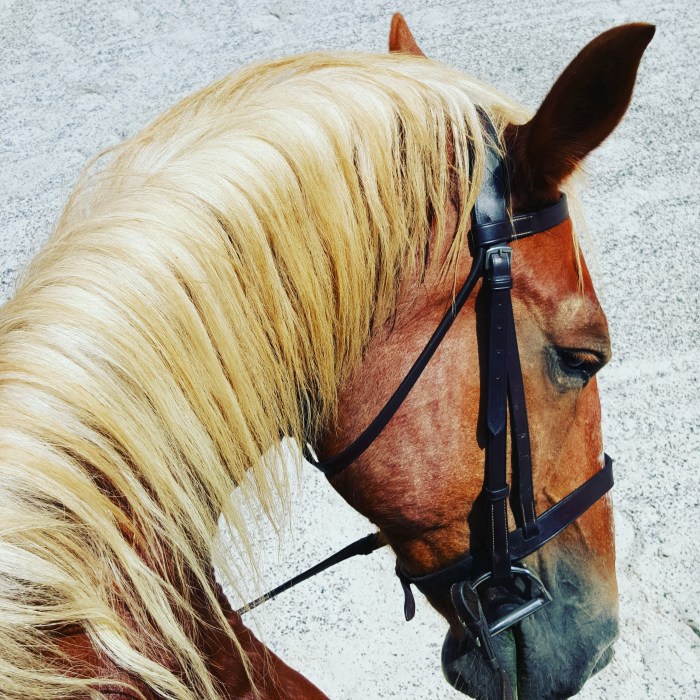
Bridleless update

What do you do on a near 80 degree day in February when you only have an hour and your fur beast still has his full winter coat?

20170224_131424
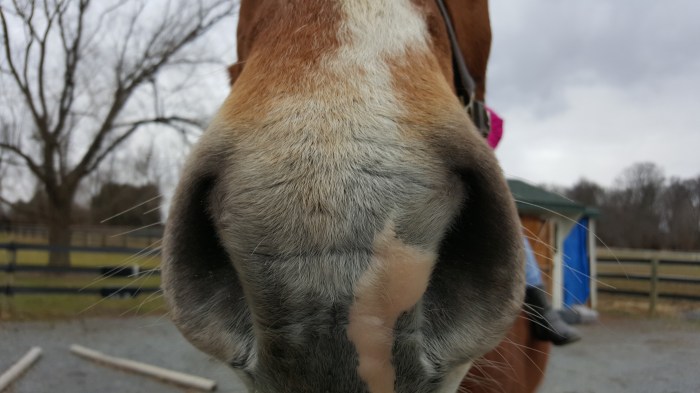
Midas enjoys his reward.

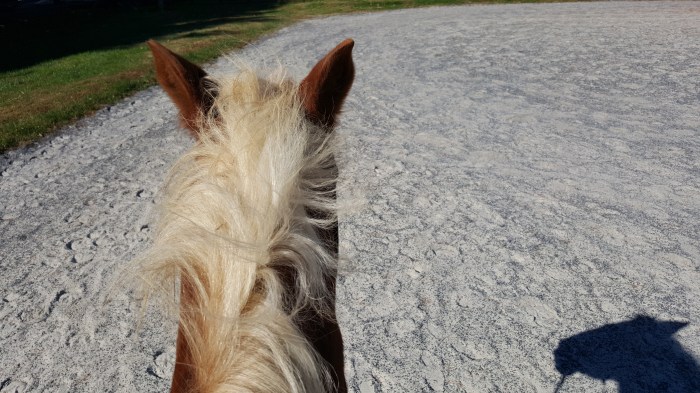
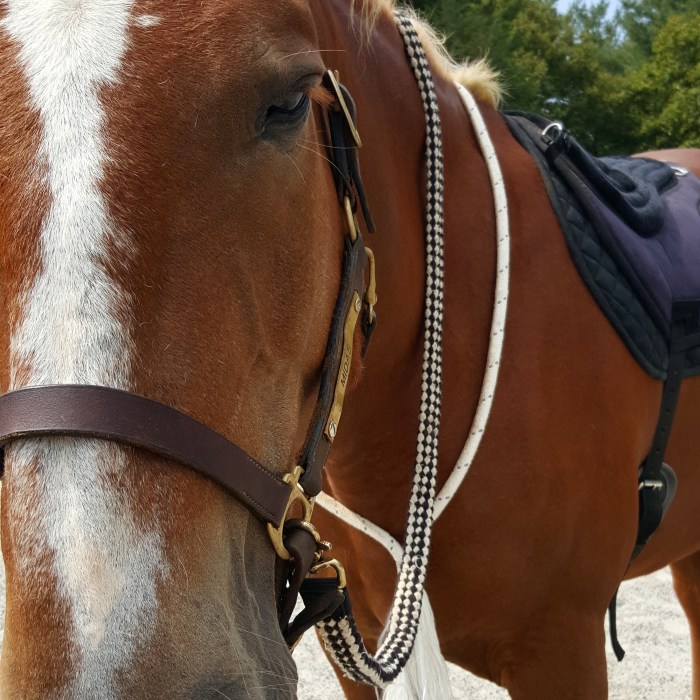
You do liberty work with the mounting block, and then you randomly decide to climb on him, without bothering to put on reins or bareback pad or anything (yes, I had a helmet).

And the horse has a moment where he tries to process that you skipped reins, and then you ride around in a wonky circle, change direction and circle the other way. Walk, halt, walk, halt. And then dissolve in delighted pattings and scratchings because you just rode a horse without reins who you were once told you couldn’t control with a rubber jointed bit.


Mice and Midas

Every week or so the Mice come to ride Midas.

He is now thoroughly and completely desensitized to high voices and powerful lungs that exuberantly greet him from a distance.

He’s also adjusted pretty well to being hugged–though I think it still bewilders him a bit. He is accustomed to children jumping away when he tries to sniff (understandable, his head is as big as they are most of the time), the first time the girls didn’t run away he nearly clocked them because he overshot.

Even Little Mouse (in the light pink) is brave enough now to stand her ground when he reaches out to sniff her.

But on his back, both Mice have always been invincible, and that feeling is only getting stronger. We had to spend a fair bit of time convincing the Little Mouse to hold on at all–I insisted because she is small, and he is big, and if anything sudden happens she could fall. She did finally believe us. But she prefers to ride with only one hand holding on whenever she can manage it.

I give them little tips to help them balance and how to communicate with the horse. Often it’s just me pointing out that she did, in fact, tell him to do the thing he just did, and here’s how. I teach them balance and confidence exercises (around the world is so much fun!) and keep a weather eye on the horse and the world around in case of spooks. But otherwise, I let the Big Mouse play. She is seven–playing is what you SHOULD be doing at that age. She’ll find the best way to sit on the horse all on her own, she doesn’t need to laden down with equitation. We’ll refine hand position later. Probably as a natural byproduct of her wanting to complete some insane obstacle course on his back.

He’s so big, and she’s so little, we still haven’t trotted. But we’re getting closer to that. The peppy walk that is nearly a jog doesn’t scare her anymore. I may offer to trot next to her next time if she’s up for it.

They love, love riding bareback. We tried the saddle the first couple times, but it is far too big, and the stirrups just get in the way and make riding harder. So their foundation shall be the very best kind.

Downright Xenophon and Spanish Riding School.

Midas is also continuing to improve on his mounting block manners. We worked on it hard over the summer, just him and me. But with the littles, he is asked to sidle up to the mounting block for them to mount and dismount.

So, it’s pretty much an awesome arrangement for everyone. Midas learns, they learn. Everyone has fun. Midas eats grass. Everyone is happy.

Jumping

20161114_122833.jpg
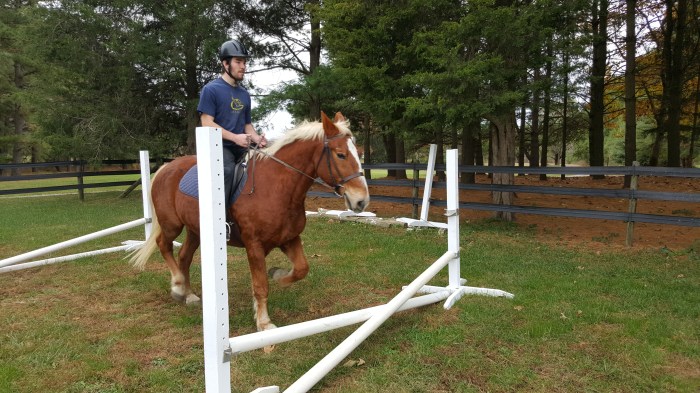
The Ham and Midas performing the same exercises I’ve been doing with Midas.

I originally thought that Midas bucking after fences was what caused his owner to fall off in the hunt field a few years ago. Now, after watching things unfold after I took a tumble at the jumper show, I think that the first fall was just because stuff happens. And I think that it freaked Midas out, and that is why he charges and bucks.

It’s like jumping becomes tearing off a band-aid–do it fast! And the buck is a precaution to stop the evil from landing on his withers.

It took a lot of schooling to be able to jump him reliably–he has athleticism in spades but expects the worst and his instincts tell him to believe he’s on his own. He’s a challenge to ride because you really do have to ride. But he’s so rewarding.

So we took all our practice at trotting combos like a pro and threw something really outside his comfort zone at him–new place, a course, and actual 2′ verticals which we really didn’t school over ever. At All. Prior to. My bad.

I’m pleased it took the verticals to cause him to revert 2 years back in training to believing the worst and that he’s on his own and he doesn’t know what to do. So he balked, rushed, and bucked. If I’d ridden better (the Great IF) and stayed on, we probably wouldn’t have this baggage about combinations.

Now he thinks “bad stuff happens when I jump, I KNEW IT” and I’m back to gently saying “No, it really doesn’t, don’t worry about it.”

First, stepping onto the grass where the jumps are got him all up and wired. Much walking onto the grass and walking of poles–under saddle, bareback, at liberty–now the grass isn’t a cue to panic.

Then we up the anti to trotting on the grass, trotting the poles and walking the half-built x rails. Also trotting the half built x-rails in hand (man, I need to wear running shoes to the barn).

I need him to sort out his own body–no rushing, take your time and do your thing. You got this. This is why I worked him in hand.

Then, in a riding lesson with my trainer, we incorporated trotting the poles, halting immediately after, then trotting the half built x-rails with a halt after.Repetition of this led to a horse willing to think about the poles, and think about the x-rails, and be ready and willing to halt immediately after.

We slowly added things: first the jump standards (one by one), then the other x-rail poles to finish it to a real x-rail. Each addition he reacted with less inclination to rush, but always he listened well. I should add that I hardly used my reins at all in this exercise–not even for halt. We’ve been working so hard on polishing up our leg and seat aids that I’m actually able to rely on them. Reins are finally relegated to their proper role as “just another aid” rather than “the aid we rely on most.”

So now we do a lot of this. A lot of “no really, you know how to use your feet, and I can ride it, you should listen to me, we’re a team.”

Then, then maybe we can add canter. Golly, what a thought. Rating the canter…we’ll get there.

What is it about fences?

Midas is a foxhunter. Though, he hasn’t gone much in the past 4 years. The hunt he typically goes out with isn’t really a break-neck crazy crew. They jump teeny logs at a run through the woods, sure, but if they come up to anything remotely serious they stop and going over one at a time in a pretty orderly fashion.

Midas is fully capable of jumping big fences from a trot.

But when we first started popping him over tiny jumps he charged them. Like, itsy bitsy x rails and he would launch at them from several strides away and hurl himself over, often bucking on the other side. I noticed that he often bucked after hopping logs, too.

It could just be exuberance.

We spent two summers casually sneaking in work over small jumps, endeavoring to teach Midas that jumps are casual affairs. No charging necessary or desired. Last year the fruits of that labor really started to show, we could randomly and casually take a little bounce that was set up in a corner of the ring. Midas would ride up like a gentleman, own the bounce in style, and canter out slowly. He was happy, we were happy.

Progress.

Well, then we upped the anti–maybe too much?–with that little jumper show. We schooled pretty hard for it in the few days beforehand, and then had a very exciting little show. In which Midas owned the trotted x rails with only a little nervous rushing, and then we had a disaster on the 2′ fences, and then we came back and jumped individual fences quietly, but didn’t even remotely mess with doing a course.

Now, in the midst of prep for the show my trainer asked me to pick up canter with the intent to canter jump. Midas did something he hasn’t done at home with me–ever–and gave a genuine buck and took off. He didn’t get far, I stopped him, and then we had a nice obedient canter depart and left cantering fences for a different day.

By the end of the lesson he was being a serious champ about trotting whatever combination I asked of him. Even some with tricky steering.

So, at the show, he kind of ducked and crow hopped after almost every 2′ fence. Except fence 4, which according to the trainer there was an inviting fence–and fence 5, which was the first of a simple line that had three canter strides between 5 and 6. Well, shame on me, I didn’t sit up enough for those canter strides, got jumped out of the tack on 6 and this time fell off when he did his duck and crow hop routine.

Then we had digging out to do in the warm up, and it didn’t occur to me until too late today that Midas hasn’t jumped a combination since then. I’ve been traveling, we’ve had visitors, and I felt like I had a bit of sweeping up to do to remind him of all the things that haven’t changed.

The Ham was riding Midas today–the Ham is 17, and has been riding with me for 6 years, much of that time on Midas. He went to pop over the teeny tiny x rail in and out. Shouldn’t have been a big deal. Two months ago I don’t think it would have been a big deal. Might be wrong, but…

The ride, up until the moment he pointed Midas at the combination, had been exceptionally quiet and easy going. But Midas launched himself at the first x rail and then lurched sideways–running out from the second fence and making for the gate.

The Ham rode the run-out fine, but the saddle slipped onto Midas’s side and the poor Ham was dumped roughly on his back.

Midas stopped a few feet away and stood like a statue. He didn’t move a muscle and starred at the Ham as the poor guy struggled to catch the wind that had been knocked out of him. Once the Ham was on his feet again I went to Midas, who continued to stand so still that I was afraid he was hurt. I checked him over. Nothing that I could see.

I fixed the saddle, tightened the girth, led him to the mounting block and got on. He felt sound but hesitant. Like he expected something bad to happen. We did some transitions up and down, he wasn’t wound up, but rather hesitant and almost nervous.

We went to grassy area with the teensy x rails and walked around them. He was nervous again–now Midas’s nerves do not mean skittishness and shying generally, Midas nerves mean head up and charging. We walked over the tiny jumps, threw in some trot transitions. Each time he would seize up and get tense, and I’d have him walk again. I had the Ham put the tiny x rails down to poles and we walked and trotted over those both ways, then he put one up to an x rail and we walked and trotted that a couple times.

Midas would start to tense, then listen when I soothed him. He trotted the solitary x rail reasonably, even if he needed to be ridden up to the base as if it were a big scary jump.

Then the Ham got back on, good man, and basically started the whole procedure over again from scratch. They didn’t get to popping over the one jump, but they started from a more nervous place and ended relaxed. Mostly relaxed, anyway.

So what is it?

I’ve noticed that when there is a fall, Midas gets freaky about what he was doing when the fall happened. Never mind that he’s usually a contributing factor to the fall, but he gets squirrely about doing that thing again.

It’s like his thought process is “Nope, last time I jumped two in a row someone fell off and it was scary and I got in trouble so I am NOT jumping two in a row.” or “Last time I cantered a jump it didn’t go well, not happening.”

Susu, our trainer, with whom we only get to ride a few times a year, says that he doesn’t have any tools in his toolbox to deal with jumping. He’s got athletic ability, and has relied on that to survive.

This would explain the charging.

I know that I don’t have a lot of experience cantering fences (neither does the Ham). I was never stellar at seeing distances, and only cantered courses a handful of times in my high school days (yay for the constraints of a 20 x 40 dirt arena in the north). There just hasn’t been opportunity since. I know that I don’t necessarily ride him as strongly as he might want or need when there are two fences in a row. So there is that.

This would explain the abashed behavior when people fall off. He always seems so surprised when he loses a rider.

If Monty Roberts is right about the wiring of horses, I need to approach this the same way I would approach a person who had something scary happen. Keeping at it in as low pressure of a fashion with as much support as he needs to not panic and figure out that he can, in fact, handle it.



Chomping

Midas has this annoying little habit of yanking on the reins when he’s standing. He’s done it as long as I’ve known him, and it’s pretty much never been a priority for me to deal with.

First lesson was don’t move your feet without permission. There were days when it was 10-15 minutes before I asked him to walk from the mounting block because he would not wait for permission to leave.

Those days are past (not without occasional reminders) and we’re not working well enough under saddle that I feel I can spare some time to work on the yanking habit.

My seat has improved to the point that when he yanks he’s mostly just yanking on himself, he does not succeed in pulling me out of the saddle or the reins out of my hands. (Yay for tucking your seat under!)

But it’s a habit, and he still does it.

Monty Roberts once recommended in his “Ask Monty” column that you back a horse each time he yanks, eventually he’ll figure out that if he yanks he has to work more. I originally intended to pursue this method, but I may have stumbled on something simpler for Midas.

Yesterday I took the time to throw halt transitions in with our regular work. Not just halt, but halt and wait. It only takes a couple seconds for Midas to yank on the reins. Then we would wait more. When he passed the couple seconds mark wihout yanking (often replaced with a sigh) then I give him a loose rein.

Then I gather up the reins again and wait (this is often accompanied by feet shuffling, which I wait out, since I didn’t ask him to move his feet and he’ll get no reward for it.) Once he is standing, and accepts the contact–passing that couple second mark without yanking (again, usually accompanied by a sign) I give him a loose rein. After repeating this a couple times, I ask him to move forward. Sometimes with contact, sometimes without.

He responded really well. Each time we did this there was less yanking and more waiting quietly. The last time I don’t remember him yanking at all.

I’m sure it will take more than one ride to break a habit he’s had for at least 10 years, but I think he’s starting to realize what he’s doing and that there is a better way.