
Apparently most artists go through a blue period. It’s because blue is such a wonderful color. So much depth and feeling and warmth and comfort and richness and….you get the idea.
Also, that black-like color? I mixed that. On purpose. Progress!

Apparently most artists go through a blue period. It’s because blue is such a wonderful color. So much depth and feeling and warmth and comfort and richness and….you get the idea.
Also, that black-like color? I mixed that. On purpose. Progress!
Windy day, freshly brushed mane…

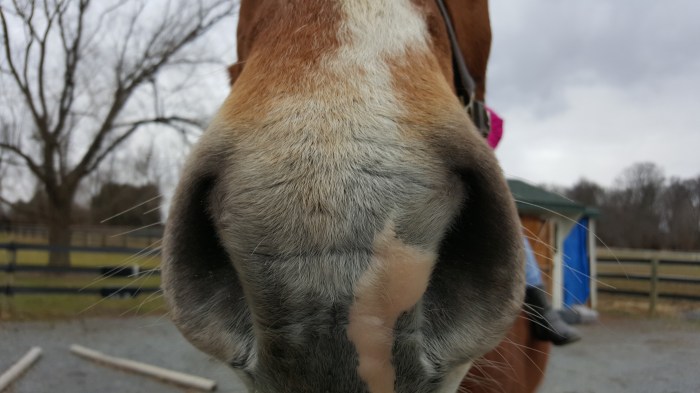
Every week or so the Mice come to ride Midas.
He is now thoroughly and completely desensitized to high voices and powerful lungs that exuberantly greet him from a distance.
He’s also adjusted pretty well to being hugged–though I think it still bewilders him a bit. He is accustomed to children jumping away when he tries to sniff (understandable, his head is as big as they are most of the time), the first time the girls didn’t run away he nearly clocked them because he overshot.
Even Little Mouse (in the light pink) is brave enough now to stand her ground when he reaches out to sniff her.
But on his back, both Mice have always been invincible, and that feeling is only getting stronger. We had to spend a fair bit of time convincing the Little Mouse to hold on at all–I insisted because she is small, and he is big, and if anything sudden happens she could fall. She did finally believe us. But she prefers to ride with only one hand holding on whenever she can manage it.
I give them little tips to help them balance and how to communicate with the horse. Often it’s just me pointing out that she did, in fact, tell him to do the thing he just did, and here’s how. I teach them balance and confidence exercises (around the world is so much fun!) and keep a weather eye on the horse and the world around in case of spooks. But otherwise, I let the Big Mouse play. She is seven–playing is what you SHOULD be doing at that age. She’ll find the best way to sit on the horse all on her own, she doesn’t need to laden down with equitation. We’ll refine hand position later. Probably as a natural byproduct of her wanting to complete some insane obstacle course on his back.
He’s so big, and she’s so little, we still haven’t trotted. But we’re getting closer to that. The peppy walk that is nearly a jog doesn’t scare her anymore. I may offer to trot next to her next time if she’s up for it.
They love, love riding bareback. We tried the saddle the first couple times, but it is far too big, and the stirrups just get in the way and make riding harder. So their foundation shall be the very best kind.
Downright Xenophon and Spanish Riding School.
Midas is also continuing to improve on his mounting block manners. We worked on it hard over the summer, just him and me. But with the littles, he is asked to sidle up to the mounting block for them to mount and dismount.
So, it’s pretty much an awesome arrangement for everyone. Midas learns, they learn. Everyone has fun. Midas eats grass. Everyone is happy.


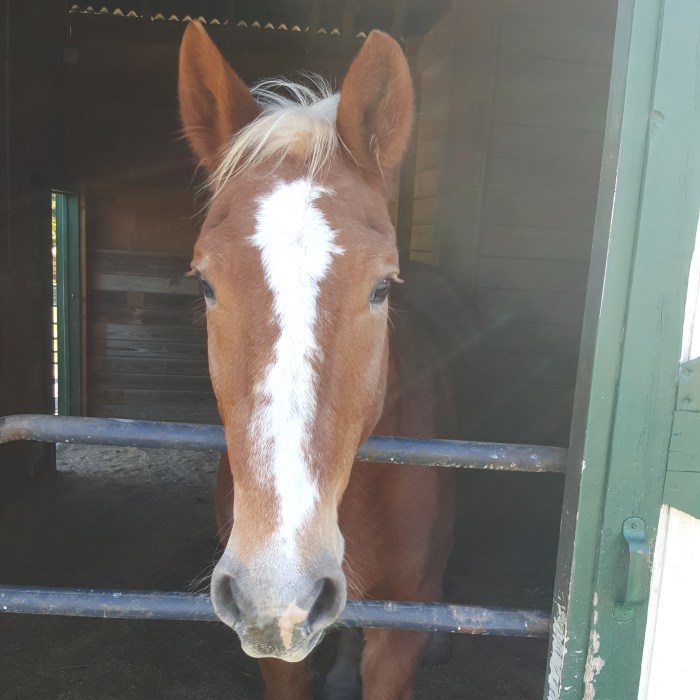
Originally published in 2014 on my other blog.
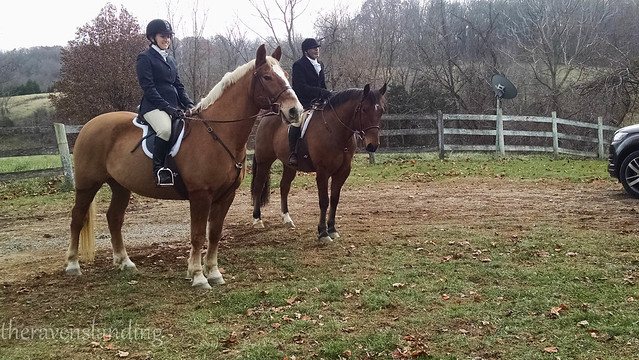
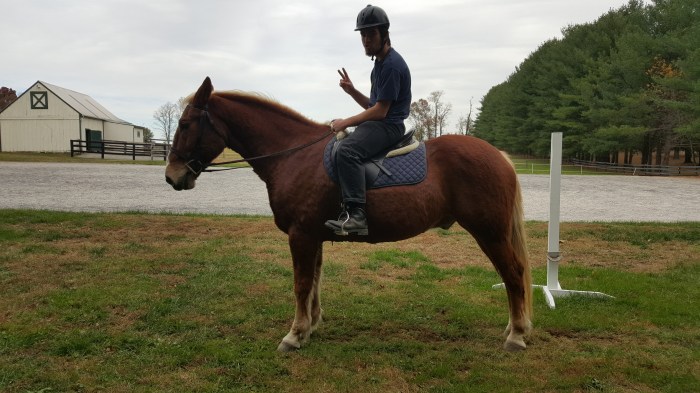
This spring and summer I rode my burly foxhunter, Midas, through fields performing the one-rein stop every 10 steps or so in order to, 1) learn the thing, and 2) not be bolted with. Now we have pretty well mastered the maneuver as taught by Clinton Anderson in his Down Under Horsemanship book–and the effects have been astounding.
The one-rein stop consists of reaching about halfway down one rein, and then in a smooth (not abrupt) motion, drawing your hand back to your hip. This draws the horse’s head around to his shoulder. Your other rein hangs completely loose. The instant the horse yields–by bringing his nose closer to you than the rein requires, thereby removing the pressure of the rein–and stops his feet, you drop the rein as a reward. Before you tackle this while moving, you master it while standing still; this way the horse already understands how to yield before you incorporate stopping.
Oddly, the one-rein stop is a very soothing exercise. It’s hard to say if it soothes the horse or rider first, but there is a calming rhythm and familiarity to it. The rider is suddenly aware that he or she can stop the horse easily and without conflict, and the horse likewise realizes that the rider won’t grab or be harsh, and it knows what to do to release the pressure. Everyone knows what to expect, and that’s very soothing.
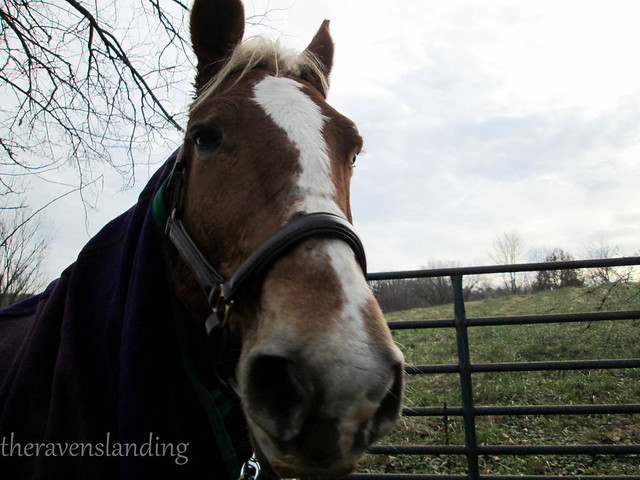 |
| This is Midas’s post-hunt-so-tired-please-can-we-stay-with-the-hounds? face. |
The net result is not only a horse who can be stopped (no small matter when you ride a horse who bolts) but a confident rider. Over the past several months, both of my young in-laws have had the opportunity to stop bolts. The most recent take-off the 16 year old rode by himself out of voice-shot and handled perfectly. He then continued with the ride as if nothing had happened, both horse and rider in a good mental state. I’m completely delighted at the prospect of bolts being non-events rather than ride-defining moments.
This has resulted in a sort of revolution for Midas and I.
Because you don’t need a short rein to stop the horse quickly, you can ride with a longer one. This has, in turn, enabled me to finally connect the dots between contact with the horse’s mouth, rein length, and sitting up straight. I’ve been actively working to sit taller (fighting those years of hunt seat equitation), tuck my seat under, and when I do have to pull on the reins or half-halt, the action comes from the elbow and shoulder rather than just the hands. Although I’m riding on a longer rein, there is not, interestingly, a loop in the rein. With all the puzzle pieces falling into place, Midas is not abusing the longer rein. Instead, he’s stepping into it and stretching his neck into it, like my High School Riding Instructor always said the horse would. We have stumbled on the secret to traveling in the fabled frame lauded by dressage instructors everywhere.
Finally and unexpectedly, the longer rein has suddenly enabled us to canter. It’s embarrassing, but I couldn’t induce Midas to canter much in the ring; and it was hard work to hold him balanced when we did canter. As it turns out, I was holding his head too high with a too-short rein, and he was having to work his tail off to stay balanced at all. On the longer rein–with my elbows and shoulders back and my seat tucked under–he reached of his own accord into the contact of the rein, and I could use my legs and seat to keep his weight back and balanced.
The confidence of the one-rein stop unlocked a palace of riding treasures for my bolt-prone mount and I. It has lessened the frequency and severity of bolting incidents, led directly to mastering other horsemanship skills and concepts, and given us the ability to canter responsibly. The One-Rein Stop is great.
This post originally appeared on my other blog March, 30, 2015. I have updated and added some information.
It’s probably J.R.R. Tolkien’s fault. Shadowfax and the exceptional horses of Rohan have made super-smart horses an important part of high fantasy. Even without an attempt on personification, horses also tend to be important features of any story lacking automation. How else do you get from point A to point B quickly? Did you have to look up how to cook a rabbit to write that one scene? Treat your transportation with the same care.
Why do some book horses work really well, and others are like fingernails on chalkboard? There are a lots of reasons, of course. I will grant you, that there are readers who won’t notice your poor horsemanship. But, are you really satisfied with being sub par? Here are some tips for writing a believable horse:
1-Remember that horses are prey.
They like to eat grass and sometimes play. Their first instinct when something startles them is to put distance between them and the thing. Horses can be trained to think first, and can be taught not to react to scary things–like, you know, cannon fire–but it is taught, not inborn. That said, some horses are better suited to this than others.
This is also why war horses are so valuable.
2-Horses are athletes.
Think about human fitness for a moment, and that should put things in perspective. Top speed for the horse as a species is 45 mph. This is a very fast horse. A very fast horse in peak condition can probably do 45 mph for maybe three miles before needing to slow down.
That said, back in the day horses worked for a living, so chances are that most horses were fit.
Endurance racing is a thing, look it up to get a feel for the timing and pacing of urgent travel.
The pony express is a decently documented courier service if you need a model for king’s messengers getting around.
3-Gender matters.
When they filmed the first three Lord of the Rings movies they relied a lot on stallions. Shadowfax was played by two Andalusian stallions, Asfaloth was a different Andalusian stallion. And of course Aragorn’s horse, Brego, was played by a stallion. Most of the time this wasn’t a problem (though there was a reason there were two Shadowfaxes) but you know that scene at the Black Gate? One minute they are on horses, the next all the horses are gone and there is no explanation? That day, one of the cavalry mares was in heat and the stallions got downright dangerous. Now, on a film set, there is a lot of standing still. If there had been a lot of galloping, it probably would have been fine. But I laughed when watching the making of features on The Hobbit films, because there was not a stallion in sight on that set. Peter Jackson learned his lesson.
Historically, the Bedouins preferred mares as their war horses because the mares were quieter and less likely to give away surprise attacks. Stallions like the world to know they exist–especially other stallions. A well trained stallion can still be an excellent mount, and I imagine a world where horses work for a living would produce more good citizen stallions than this one does. (There are a few breeds more prone to gentle stallions than others, but on the whole they have a lot of testosterone and need to be very well trained to be safe. Most professional trainers advise extreme caution when handling stallions.)
That said, mares get close to geldings and then squeal. It’s a very annoying form of flirtation.
Geldings are neutered males. This is done to limit unwanted horse production, and to make the males more manageable. Granting that horses are individuals, geldings are extremely reliable creatures. These days, I’d take a gelding over a mare any day if I needed to sneak somewhere. I don’t think gelding was a thing in ancient times, though. If you are writing fantasy, you could argue they’ve developed it.
While we’re on the topic, baby horses are foals (not ponies). Girls (up to age 5) are fillies, boys (up to age 5) are colts. After that it’s mare and stallion or gelding. Ponies are horses under 14.2hh* but there are also pony breeds (see Shetland) and there are a couple small horse breeds (Icelandic Horses and miniature horses, for example) which are called horses. Exceptions make the rule, as they say.
4. On Whinnying.
Movies love to make horses whinny. Horses don’t actually whinny often. See “prey” above.
Here are some circumstances when a domestic horse might whinny:
-The horse is alone and uncomfortable in unfamiliar territory and smells another horse.
-The horse is alone, approaching home more slowly than he wants and smells a stablemate (this is rare among horses who are accustomed to traveling alone).
-The horse is completely terrified and can’t get away (such as fire, or a fall).
-The horse has attachment issues to another being (probably a horse) and is separated from that being.
-The horse is home, but smells another horse coming and for some reason wants to say hi.
-Stallions making a statement, see below:
Here are some circumstances when a horse might squeal:
-Play fighting.
-Flirting.
-Real fighting.
Here are some circumstances when a horse might nicker:
-Dinnertime.
-Favorite being’s arrival or departure.
-Snacktime.
From what I’ve read, wild or formerly wild horses really don’t whinny ever. They take the world too seriously to risk attracting predators, I guess.
5-When you personify horses, think through just how sentient you want this creature.
Refer back to item 1, and set your ground rules. You can give your horse a completely human personality, but make sure you actually decide that. Disney/Pixar’s approach to the personified horse is usually to pretend the horse is a personified dog (see Maximus and Bullseye).
6-If you have not personified your horse, don’t personify your horse.
Yes, I know I describe Midas like a person when I talk about training. He has a distinct personality, but he’s just a horse. He’s smart, knows and cares what I want him to do, and sometimes looks me straight in the eye and does the forbidden thing on purpose. Horses in real life are a lot like toddlers.
They gut react to strangers, they get antsy when they are bored or cooped up. But if they have a job, they love having a job to do. They also love being done with their job and free to do what they want. If they know you and trust you, they’ll be happy to be around you and more willing to do whatever you ask.
Horses recognize people, and remember events and feelings. They are excellent judges of people–for lack of a better descriptor, they pick up vibes from people and react accordingly. That said, a well trained horse isn’t going to be reacting hugely unless the person’s behavior sets them off.
Horses are problem solvers, some have developed this characteristic more than others. Some are hyper curious, some are super sociable, some are pranksters.
Some horses are braver than others.
7-Tack (horse equipment).
Every part of the world has their own version of saddles and bridles. But in English they are called saddle and bridle. Bridles are for riding, halters are for handling on the ground. The rope for leading a horse is called lead rope. If you don’t have a halter, you can hobble a horse–IE use a rope or something similar to tie a horse’s forelegs together so the horse cannot go far or go fast. Cowboys, in particular, used hobbles.
Grooming essentials are a brush for dust/dirt, a curry comb of some sort to deal with crusted mud, and a hoof pick for cleaning out hooves.
Realistically, you probably don’t need to know much more than this unless you’re writing a period piece.
This is a saddle:
 |
| source |
Saddles have stirrups for the rider’s feet, and a girth to hold them on. They have a pommel at the front, and the back is called a cantle. and the thing that hangs down between the stirrup and the horse is a flap.
This is a bridle:
 |
| source |
A bridle usually holds a bit in the horse’s mouth, has reins attached, and is specifically for riding. The part that goes across the horse’s forehead is a browband, the part behind the ears is the crown, the part under the throat is the throat latch.
This is a halter:
 |
| source |
Halters take many forms, some more simple than others, but the main thing is that it’s for handling the horse (or cow, or sheep, for that matter) from the ground.
Usually, a harness only refers to the trappings hitching a horse to a cart/plow/chariot:
.png/1024px-Harness_(PSF).png) |
| source |
8-Lameness.
It happens. A horse who is lame is called lame or off, a horse who is not lame is called sound. If, for the sake of plot, you need to deprive your hero of his mount there are a number of ways. Horse thieves are always an option. As are spook/bolts. Assuming your hero is not in a position to lose his horse thusly, or plot demands it for another reason, your horse could come up lame. The possibilities here are endless but here are a couple common options:
–Lose a shoe. Unless your hero carries around special pliers for pulling off all the other shoes, your horse will be gimping along pathetically. This is a very fixable and temporary lameless, but it still makes the horse unridable until you can get it fixed.
–Pick up a stone or get a stone bruise. This usually involves a stone being wedged by the shoe against the hoof and leaving a bruise. It can be an injury you walk off, of an injury you don’t recover from.
It happened to Black Beauty and made him fall on his face and dump his rider. I once had a horse step on stick–the stick actually impaled his hoof a little and I had to pull it out. He was lame for a few minutes and then walked it off. If we’d been galloping when he stepped on it, things would have been worse. Incidentally, hoof bruises are usually red.
–Mystery reason. Heat/inflammation in the leg(s) plus lameness means something is wrong. The average horse owner today would have a list of guesses, but if your knight doesn’t have a local vet to call for a diagnosis, I wouldn’t worry too much about specifics.
–Ever heard of cattle trops? These are devastating. It would be theoretically possible for a horse to live, but I find it unlikely that the horse would ever be sound again.
–Pull a tendon or ligament. This is fairly serious and you probably retired that horse from the story–unless your story spans months and months and months.
–Receive a wound in the saddle or girth area. This also probably retires the horse from the story as wounds take time to heal.
9-Age.
It takes 5 years for all the bones in a horse’s body to fuse. Age 8-18 is generally the prime of life. Some horses stay fit and healthy much longer. Some horses are overused early and burn out before age 8. I think the current oldest horse in the world is in his 50’s (happily retired in the UK).
Granting the variety of personalities in the world, young horses in general tend to be higher energy, prone to forget their lessons, and get bored easily. They are even more prone to doing silly or stupid things than horses in general. Some horses stay this way forever, but most gain wisdom with age.
There was one memorable spring day a few years ago when all the horses were high as kites–the colts especially–except the 30+ year old Shetland pony who just watched them all the way Yoda watches Luke Skywalker.
10-Ponies.
Ponies are the best things ever. They are not young horses, they are simply small. They are very clever. Much more clever than your average horse most of the time. They also tend to know they are clever, and know they are cute, and are openly willing to use those traits against you. But they are still the best ever. Hardy, long lived, sturdy. A few small breeds are still strong enough to carry a grown man. Not all breeds can carry grown men.
11. Loyalty.
Horses are reasonably loyal, but they are not dogs. They are prey. When a horse spooks its brain turns off and the horse gets the hell out of Dodge. Later on the horse will realize that it had a rider once, and now the rider is gone and they aren’t sure where they parted company. Horses live their life in circles (read up on Monty Roberts if you’re curious) so chances are they will eventually circle back to their rider. Unless they know their way home. Though, they are lazy, if they didn’t go far, they probably won’t go far. A good rider can usually stop a bolt right when it starts, it’s a bit harder to stop once a horse is fully underway, but it is still possible to regain control.
Now that I’ve said that: There are always exceptional horses. There are always exceptional bonds. There are always miracles. I read a story about a horse who charged a bear with its rider to save another horse and rider (go read that story, it’s a great example of horses and riders in a scary situation). I’ve read about horses staying with fallen riders and taking them to the nearest house where they could get help. I’ve experienced a bolting horse stopping for a traffic signal when she was in sight of the barn and had no horse reason to stop (on a related note: God answers prayers).
Don’t be afraid to have exceptional horses, bonds, and miracles, but be aware that they are exceptional.
12. Gaits.
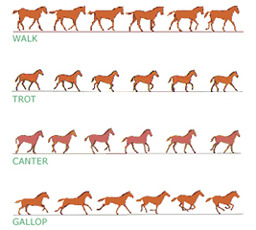
Most travel will be done at walk, and trot. Trot is a two beat gait which can be quite bumpy, the rider sits or posts (a sort of controlled rise and fall of the rear) the trot. If the rider is riding bareback, he’s sitting the trot and it’s probably not comfy unless he’s a really good rider or riding a really smooth horse.
Canter or lope is next on the speed scale, and then of course we all know gallop.
There is such a thing was a gaited horse–this is a horse with an extra gait, which is some form of running walk. There are different names for the different cadences of running walks, but one foot is always on the ground. This is an exceptionally smooth riding experience, and it looks weird. Just google “single footing horses” and you’ll see what I mean. Someone like a circuit rider or traveling monk would love it if you gave them a gaited horse to ride. These horses are ideal for long distance traveling. They are not ideal for knights unless he’s rich enough to have a separate charger.
 |
| source |
13. Terms.
If you’ve made it this far through the post you’ve probably learned or googled all the terms you really need to know. More than this, and you’re just flaunting to your reader that you’ve done research.
Unless:
You are writing a period piece, in which case I encourage you to look up the names of the gear used in that time period. Just to give you incentive: If your piece is before the Mongols, no one had stirrups. The Romans had shoes, not stirrups.
You are writing a horse story. In which case I strongly recommend spending seriously huge amounts of time around horses and horse trainers. The more the merrier. And read The Black Stallion and every single Marguerite Henry book you can get your hands on. Also read the equine encyclopedia.
You are writing a character who would know such things (such as a horse trainer, a groom, a horse enthusiast-even just a racehorse owner). In that case, read up on the particular sport or discipline, or what life was like for horses in a comparable time period (if you’re writing fantasy).
Plot. If you need the carriage to break down, wouldn’t hurt to learn what the parts of a carriage are called. If someone poisons the queen’s favorite horse, it would be important for you learn more about how much of what kind of sick a horse can actually take.
Happy writing!