What do you do on a near 80 degree day in February when you only have an hour and your fur beast still has his full winter coat?
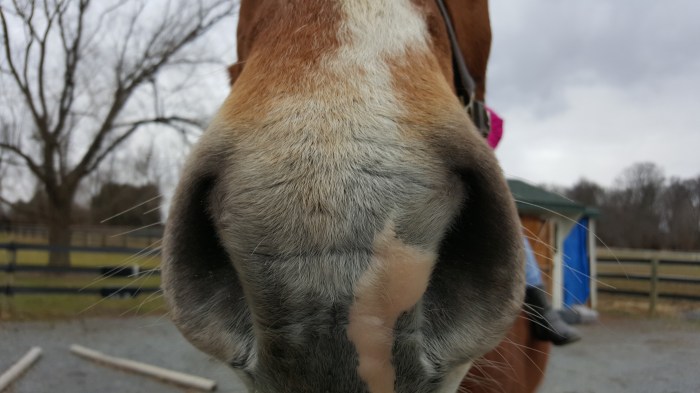
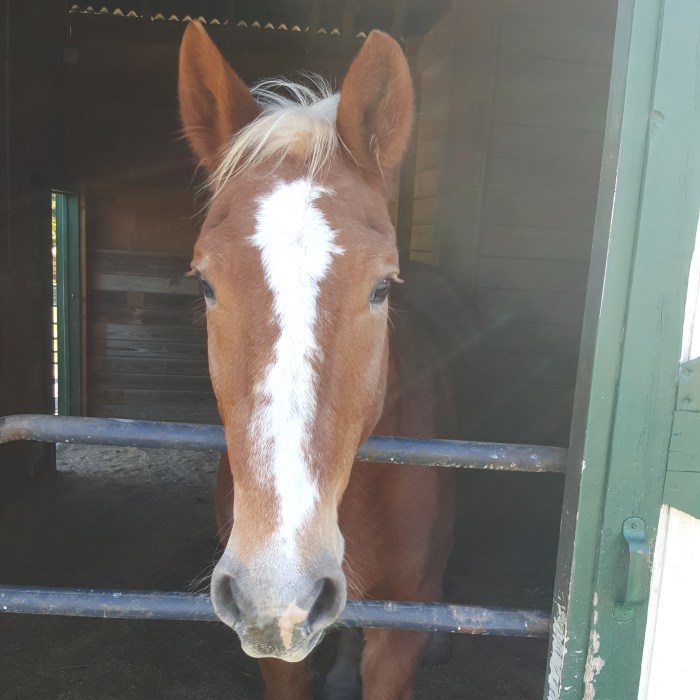
Midas enjoys his reward.
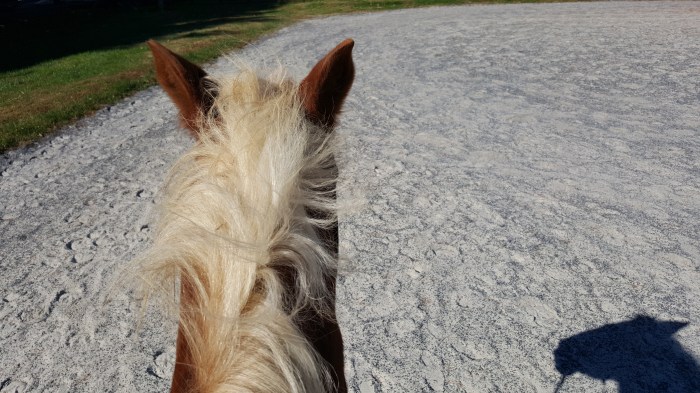
You do liberty work with the mounting block, and then you randomly decide to climb on him, without bothering to put on reins or bareback pad or anything (yes, I had a helmet).
And the horse has a moment where he tries to process that you skipped reins, and then you ride around in a wonky circle, change direction and circle the other way. Walk, halt, walk, halt. And then dissolve in delighted pattings and scratchings because you just rode a horse without reins who you were once told you couldn’t control with a rubber jointed bit.
He is now thoroughly and completely desensitized to high voices and powerful lungs that exuberantly greet him from a distance.
He’s also adjusted pretty well to being hugged–though I think it still bewilders him a bit. He is accustomed to children jumping away when he tries to sniff (understandable, his head is as big as they are most of the time), the first time the girls didn’t run away he nearly clocked them because he overshot.
Even Little Mouse (in the light pink) is brave enough now to stand her ground when he reaches out to sniff her.
But on his back, both Mice have always been invincible, and that feeling is only getting stronger. We had to spend a fair bit of time convincing the Little Mouse to hold on at all–I insisted because she is small, and he is big, and if anything sudden happens she could fall. She did finally believe us. But she prefers to ride with only one hand holding on whenever she can manage it.
I give them little tips to help them balance and how to communicate with the horse. Often it’s just me pointing out that she did, in fact, tell him to do the thing he just did, and here’s how. I teach them balance and confidence exercises (around the world is so much fun!) and keep a weather eye on the horse and the world around in case of spooks. But otherwise, I let the Big Mouse play. She is seven–playing is what you SHOULD be doing at that age. She’ll find the best way to sit on the horse all on her own, she doesn’t need to laden down with equitation. We’ll refine hand position later. Probably as a natural byproduct of her wanting to complete some insane obstacle course on his back.
He’s so big, and she’s so little, we still haven’t trotted. But we’re getting closer to that. The peppy walk that is nearly a jog doesn’t scare her anymore. I may offer to trot next to her next time if she’s up for it.
They love, love riding bareback. We tried the saddle the first couple times, but it is far too big, and the stirrups just get in the way and make riding harder. So their foundation shall be the very best kind.
Downright Xenophon and Spanish Riding School.
Midas is also continuing to improve on his mounting block manners. We worked on it hard over the summer, just him and me. But with the littles, he is asked to sidle up to the mounting block for them to mount and dismount.
So, it’s pretty much an awesome arrangement for everyone. Midas learns, they learn. Everyone has fun. Midas eats grass. Everyone is happy.
This spring and summer I rode my burly foxhunter, Midas, through fields performing the one-rein stop every 10 steps or so in order to, 1) learn the thing, and 2) not be bolted with. Now we have pretty well mastered the maneuver as taught by Clinton Anderson in his Down Under Horsemanship book–and the effects have been astounding.
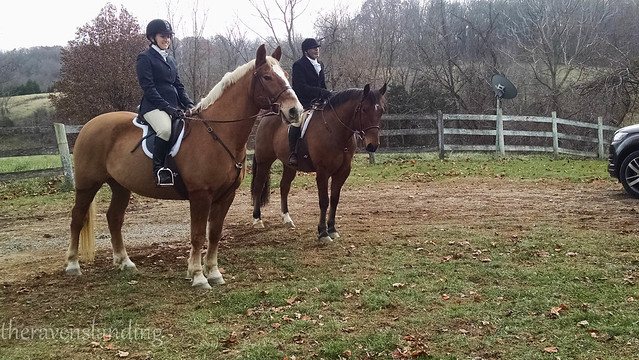
Me on Midas, Donald on Charlie
The one-rein stop consists of reaching about halfway down one rein, and then in a smooth (not abrupt) motion, drawing your hand back to your hip. This draws the horse’s head around to his shoulder. Your other rein hangs completely loose. The instant the horse yields–by bringing his nose closer to you than the rein requires, thereby removing the pressure of the rein–and stops his feet, you drop the rein as a reward. Before you tackle this while moving, you master it while standing still; this way the horse already understands how to yield before you incorporate stopping.
Oddly, the one-rein stop is a very soothing exercise. It’s hard to say if it soothes the horse or rider first, but there is a calming rhythm and familiarity to it. The rider is suddenly aware that he or she can stop the horse easily and without conflict, and the horse likewise realizes that the rider won’t grab or be harsh, and it knows what to do to release the pressure. Everyone knows what to expect, and that’s very soothing.
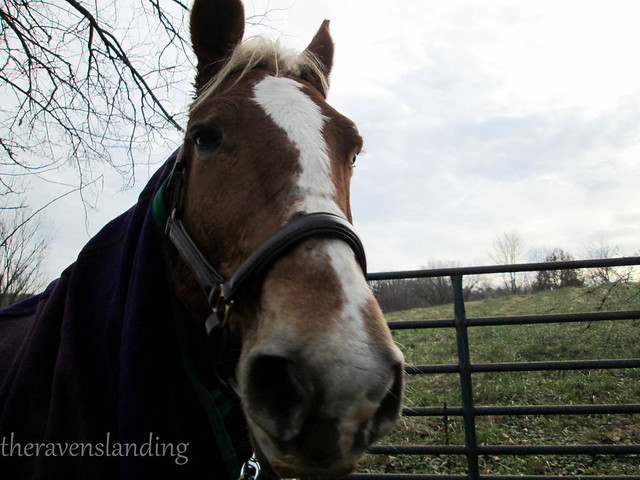
This is Midas’s post-hunt-so-tired-please-can-we-stay-with-the-hounds? face.
The net result is not only a horse who can be stopped (no small matter when you ride a horse who bolts) but a confident rider. Over the past several months, both of my young in-laws have had the opportunity to stop bolts. The most recent take-off the 16 year old rode by himself out of voice-shot and handled perfectly. He then continued with the ride as if nothing had happened, both horse and rider in a good mental state. I’m completely delighted at the prospect of bolts being non-events rather than ride-defining moments.
This has resulted in a sort of revolution for Midas and I.
Because you don’t need a short rein to stop the horse quickly, you can ride with a longer one. This has, in turn, enabled me to finally connect the dots between contact with the horse’s mouth, rein length, and sitting up straight. I’ve been actively working to sit taller (fighting those years of hunt seat equitation), tuck my seat under, and when I do have to pull on the reins or half-halt, the action comes from the elbow and shoulder rather than just the hands. Although I’m riding on a longer rein, there is not, interestingly, a loop in the rein. With all the puzzle pieces falling into place, Midas is not abusing the longer rein. Instead, he’s stepping into it and stretching his neck into it, like my High School Riding Instructor always said the horse would. We have stumbled on the secret to traveling in the fabled frame lauded by dressage instructors everywhere.
Finally and unexpectedly, the longer rein has suddenly enabled us to canter. It’s embarrassing, but I couldn’t induce Midas to canter much in the ring; and it was hard work to hold him balanced when we did canter. As it turns out, I was holding his head too high with a too-short rein, and he was having to work his tail off to stay balanced at all. On the longer rein–with my elbows and shoulders back and my seat tucked under–he reached of his own accord into the contact of the rein, and I could use my legs and seat to keep his weight back and balanced.
The confidence of the one-rein stop unlocked a palace of riding treasures for my bolt-prone mount and I. It has lessened the frequency and severity of bolting incidents, led directly to mastering other horsemanship skills and concepts, and given us the ability to canter responsibly. The One-Rein Stop is great.
The Ham and Midas performing the same exercises I’ve been doing with Midas.
I originally thought that Midas bucking after fences was what caused his owner to fall off in the hunt field a few years ago. Now, after watching things unfold after I took a tumble at the jumper show, I think that the first fall was just because stuff happens. And I think that it freaked Midas out, and that is why he charges and bucks.
It’s like jumping becomes tearing off a band-aid–do it fast! And the buck is a precaution to stop the evil from landing on his withers.
It took a lot of schooling to be able to jump him reliably–he has athleticism in spades but expects the worst and his instincts tell him to believe he’s on his own. He’s a challenge to ride because you really do have to ride. But he’s so rewarding.
So we took all our practice at trotting combos like a pro and threw something really outside his comfort zone at him–new place, a course, and actual 2′ verticals which we really didn’t school over ever. At All. Prior to. My bad.
I’m pleased it took the verticals to cause him to revert 2 years back in training to believing the worst and that he’s on his own and he doesn’t know what to do. So he balked, rushed, and bucked. If I’d ridden better (the Great IF) and stayed on, we probably wouldn’t have this baggage about combinations.
Now he thinks “bad stuff happens when I jump, I KNEW IT” and I’m back to gently saying “No, it really doesn’t, don’t worry about it.”
First, stepping onto the grass where the jumps are got him all up and wired. Much walking onto the grass and walking of poles–under saddle, bareback, at liberty–now the grass isn’t a cue to panic.
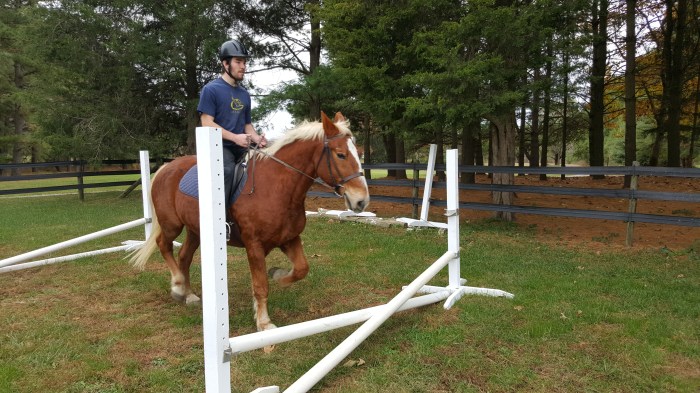
Then we up the anti to trotting on the grass, trotting the poles and walking the half-built x rails. Also trotting the half built x-rails in hand (man, I need to wear running shoes to the barn).
I need him to sort out his own body–no rushing, take your time and do your thing. You got this. This is why I worked him in hand.
Then, in a riding lesson with my trainer, we incorporated trotting the poles, halting immediately after, then trotting the half built x-rails with a halt after.Repetition of this led to a horse willing to think about the poles, and think about the x-rails, and be ready and willing to halt immediately after.
We slowly added things: first the jump standards (one by one), then the other x-rail poles to finish it to a real x-rail. Each addition he reacted with less inclination to rush, but always he listened well. I should add that I hardly used my reins at all in this exercise–not even for halt. We’ve been working so hard on polishing up our leg and seat aids that I’m actually able to rely on them. Reins are finally relegated to their proper role as “just another aid” rather than “the aid we rely on most.”
So now we do a lot of this. A lot of “no really, you know how to use your feet, and I can ride it, you should listen to me, we’re a team.”
Then, then maybe we can add canter. Golly, what a thought. Rating the canter…we’ll get there.